ACC vs Private Insurance in NZ: Understanding the Gaps
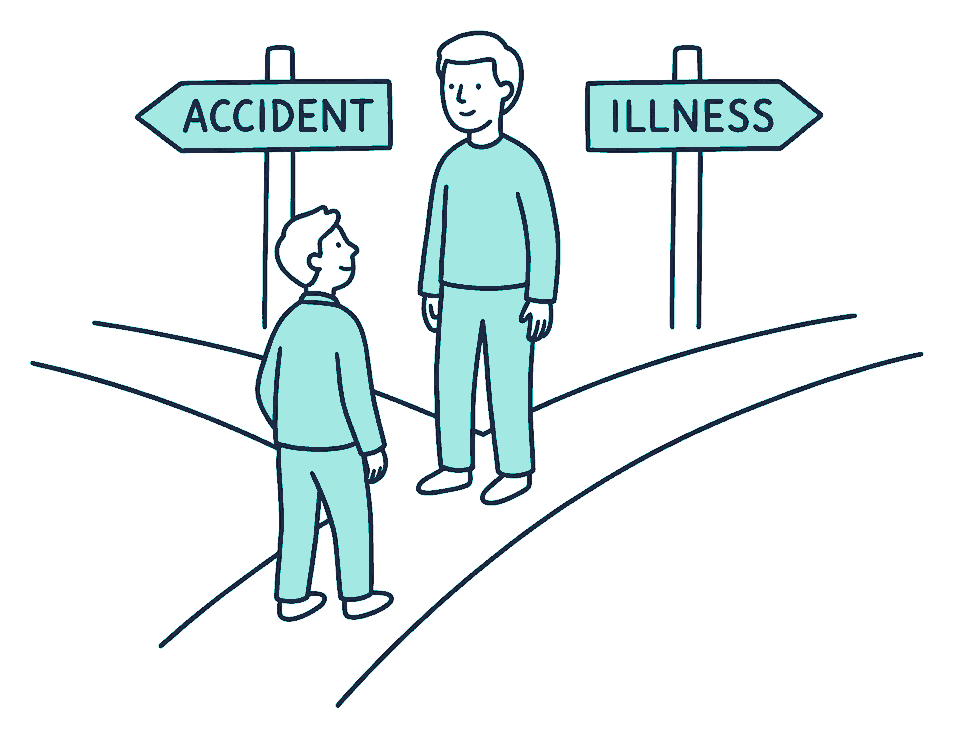
ACC covers accidents only and private insurance covers illness as well, and QuoteHub finds that single difference decides most New Zealand claims. ACC replaces 80% of pre-injury earnings up to $2,466.20 gross a week from 1 July 2026, and pays nothing for cancer, heart disease or stroke. Income protection typically replaces up to 75% of income for accident or illness alike.
In short
- ACC pays only for personal injury caused by an accident, so cancer, heart disease, stroke and most gradual conditions are excluded.
- Weekly compensation is 80% of pre-injury earnings, capped at $2,466.20 gross a week from 1 July 2026, on maximum liable earnings of $156,641 for 2026/27.
- Income protection typically replaces up to 75% of income for illness as well as injury, and most policies offset ACC on accident claims.
New Zealand's Accident Compensation Corporation registered 2,102,566 claims and paid $8,148 million in the year ended 30 June 2025 (ACC Annual Report 2025, published 9 October 2025, retrieved 18 August 2026). Every one of them was for a personal injury, because personal injury is the only thing ACC covers. No-fault cover for every person in the country is a genuine strength, and it is also where the false sense of security starts.
ACC is excellent at what it does. But what it does has clear boundaries. It covers accidents. It does not cover illness. It caps your income replacement. It does not pay if you are diagnosed with cancer, have a heart attack, or develop a chronic condition that stops you from working.
This guide provides a comprehensive comparison of ACC and private insurance in New Zealand, explains where the gaps are, and helps you understand which types of private cover are most important for your situation.
What ACC Actually Covers
ACC covers personal injury caused by an accident for everyone in New Zealand, on a no-fault basis, funded by levies from employers, employees, motor vehicle owners and government. Cover includes treatment costs, weekly compensation at 80% of pre-injury earnings, rehabilitation and death benefits for dependants. In the 2024/25 financial year ACC registered 2,102,566 claims and paid $8,148 million in claims (ACC Annual Report 2025, published 9 October 2025, retrieved 18 August 2026).
The scope of ACC cover
ACC covers personal injuries caused by accidents. This includes:
- Treatment costs (GP visits, physiotherapy, specialist consultations, surgery)
- Weekly compensation at 80% of your pre-injury earnings
- Rehabilitation services
- Home and vehicle modifications if needed
- Lump sum compensation for permanent impairment
- Death benefits for dependants
The key limitation
ACC's fundamental limitation is its trigger: it only activates for accidents. An accident is defined as a specific event or series of events involving the application of external force or resistance. This means ACC does not cover:
- Illnesses and diseases (cancer, heart disease, diabetes, respiratory conditions)
- Gradual process injuries (repetitive strain injuries that develop over time)
- Age-related deterioration (arthritis, joint wear)
- Mental health conditions (unless directly caused by a covered physical injury or specific workplace events)
- Conditions with no identifiable accident cause
This is the single most important gap in New Zealand's social safety net, and it is the primary reason private insurance exists.
ACC Weekly Compensation: The Numbers
ACC weekly compensation pays 80% of pre-injury earnings, subject to a floor and a ceiling. The minimum for full-time earners is $766.40 gross per week from 1 April 2026, and the maximum is $2,466.20 gross per week from 1 July 2026, based on maximum liable earnings of $156,641 a year for 2026/27. Earnings above that cap are not replaced.
ACC compensation rates (from 1 April 2025)
ACC's own published rates set both a floor and a ceiling. Weekly compensation is 80% of pre-injury weekly earnings, with a full-time minimum of $766.40 gross a week from 1 April 2026 and a maximum of $2,466.20 gross a week from 1 July 2026. Maximum liable earnings for levy purposes are $156,641 a year for 2026/27.
| Parameter | Amount |
|---|---|
| Compensation rate | 80% of pre-injury weekly earnings |
| Minimum weekly compensation (full-time earners, from 1 April 2026) | $766.40 gross per week |
| Maximum weekly compensation (from 1 July 2026) | $2,466.20 gross per week |
| Maximum liable earnings for levy purposes (2026/27) | $156,641 per year |
| Earners' levy rate | $1.67 per $100 of liable earnings |
| Maximum annual earners' levy | $2,551.59 |
ACC levy changes for 2026/27
The earners' levy rose at the start of the 2026/27 levy year. It moved from $1.67 per $100 of liable earnings to $1.75, and maximum liable earnings from $152,790 to $156,641, lifting the most an earner can pay from $2,551.59 to $2,741.22 a year. Both rows are ACC levy-year figures, effective 1 April.
| Period | Levy Rate | Max Earnings | Max Levy Payable |
|---|---|---|---|
| 1 Apr 2025 to 31 Mar 2026 | $1.67 per $100 | $152,790 | $2,551.59 |
| 1 Apr 2026 to 31 Mar 2027 | $1.75 per $100 | $156,641 | $2,741.22 |
What the income cap means in practice
If you earn $150,000 per year, ACC will replace 80% of that income, giving you roughly $120,000 annually (before tax) while you recover from an accident. But if you earn $200,000, the cap at $152,790 in liable earnings means ACC will only replace 80% of $152,790, leaving a significant shortfall.
For high earners, the gap between actual income and ACC compensation can be tens of thousands of dollars per year.
The Side-by-Side Comparison
ACC and private insurance differ most on what triggers a claim. ACC pays only for accidents, replaces 80% of earnings and caps weekly compensation at $2,466.20 (from 1 July 2026), while income protection in New Zealand typically replaces up to 75% of income for accident or illness, and life and trauma cover pay lump sums ACC does not offer.
| Category | ACC | Private Insurance |
|---|---|---|
| What triggers a claim | Accidents only. Must be a specific event involving external force or resistance. | Accidents and illnesses. Income protection covers inability to work from any cause. Life insurance covers death or terminal illness. Health insurance covers medical treatment for any condition. |
| Income replacement rate | 80% of pre-injury earnings. | Typically 75% of income (income protection). No cap on most policies. |
| Income cap | Capped at $2,466.20 gross per week from 1 July 2026. | Income protection is based on your actual income, insured up to the policy's own limits. |
| Illness cover | Not covered. Cancer, heart disease, stroke, and other illnesses are excluded. | Fully covered by income protection and trauma insurance. |
| Gradual process injuries | Generally not covered. ACC may decline claims for injuries that developed over time. | Covered by income protection, which does not distinguish between accident and illness. |
| Mental health | Only if directly caused by a covered physical injury, work-related trauma, or specific qualifying events. | Covered by most income protection policies (subject to policy terms). Some health insurance policies also cover psychological consultations. |
| Medical treatment | Covers accident-related treatment through the public system. Limited choice of provider. | Health insurance provides access to private hospitals, choice of specialist, shorter wait times, and non-Pharmac medications. |
| Rehabilitation | Provides rehabilitation for covered injuries. ACC may require you to return to "any suitable job." | Income protection typically uses an "own occupation" definition. You are covered if you cannot do your specific job, not just any job. |
| Lump sum payment | Lump sum for permanent impairment only. Assessed on a schedule of injuries. | Life insurance and trauma insurance pay lump sums based on policy terms, not injury schedules. |
| Death benefit | Funeral grant and survivor benefits for dependants. | Life insurance pays your chosen sum insured to nominated beneficiaries. Typically much larger than ACC death benefits. |
| Cost | Funded by levies. Earners' levy is $1.67 per $100 of earnings (2025/26). | Premiums vary by age, health, occupation, and cover amount. You choose how much to pay based on the cover you want. |
| Choice and control | No choice. ACC is a universal scheme with standardised benefits. | Full control over cover type, amount, provider, and policy features. |
Where the Gaps Hit Hardest
Five gaps separate ACC from what a New Zealand household actually needs. ACC excludes illness entirely, caps income replacement at maximum liable earnings of $152,790, can require a return to any suitable job rather than your own occupation, covers mental health only in narrow circumstances, and gives self-employed workers accident-only cover through CoverPlus and CoverPlus Extra.
Gap 1: Illness is not covered
This is the biggest gap. According to health statistics, you are statistically more likely to be unable to work due to illness than injury at some point in your working life. Cancer, cardiovascular disease, musculoskeletal conditions, and mental health conditions are among the leading causes of long-term absence from work, and none of these are covered by ACC.
Income protection insurance fills this gap directly. It pays you a monthly benefit if you cannot work, regardless of whether the cause is an accident or an illness.
Gap 2: Income replacement is capped
ACC replaces 80% of your income, but only up to the maximum liable earnings threshold of $152,790. If you earn more than this, the gap between your actual income and ACC compensation grows with every dollar.
Even at lower income levels, the 20% reduction in income can be significant. If you earn $80,000 and ACC pays you 80% ($64,000), the $16,000 shortfall over a year of recovery is a meaningful financial hit.
Conventional income protection offsets ACC payments for accident-related claims rather than paying on top of them. Its full benefit applies to illness, where ACC pays nothing. Some products interact differently: certain mortgage-repayment covers do not offset ACC, and specific-injury benefits pay a set amount regardless of ACC. The policy wording decides, so check it before assuming the covers stack.
Gap 3: Return to "any suitable job"
ACC's rehabilitation focus is on getting you back to work as quickly as possible, which is generally positive. However, ACC may determine that you are fit for "any suitable job," not necessarily your previous role. If you were a surgeon and ACC decides you can work as an administrator, your compensation may be reduced or ceased.
Most income protection policies use an "own occupation" definition, which means you are covered if you cannot perform your specific job. This provides much stronger protection for professionals and skilled workers.
Gap 4: Limited mental health cover
ACC covers mental health conditions only in narrow circumstances: as a direct result of a covered physical injury, specific work-related events (such as experiencing or witnessing a traumatic event at work), or sexual assault. General mental health conditions like depression, anxiety, and burnout are not covered.
Given that mental health conditions are among the fastest-growing causes of inability to work, this is a substantial gap. Income protection with mental health cover addresses this.
Gap 5: No cover for self-employed income variability

Self-employed workers can access ACC through CoverPlus or CoverPlus Extra (CPX). CoverPlus bases compensation on your previous year's liable earnings, which may not reflect your current income. CPX allows you to nominate a cover level, but this is still accident-only.
For self-employed individuals, private income protection is particularly important as it can cover both accidents and illnesses at a level that reflects your actual earning capacity.
Types of Private Insurance That Fill ACC Gaps
Four private products fill the ACC gaps in New Zealand. Income protection replaces up to 75% of income for illness as well as injury. Life insurance pays a lump sum on death or terminal illness, commonly $500,000 to $1,500,000 for a family with a mortgage. Trauma insurance pays on diagnosis, and health insurance funds private treatment.
Income protection
Replaces a portion of your income (typically 75%) if you cannot work due to illness or injury. This is the most direct complement to ACC, covering everything ACC does not: illness, gradual process injuries, and mental health conditions.
Life insurance
Pays a lump sum to your beneficiaries if you die or are diagnosed with a terminal illness. While ACC provides some death benefits, they are modest compared to what a life insurance policy can provide. A life insurance sum insured of $500,000 to $1,500,000 is common for families with a mortgage and dependants.
Trauma insurance
Pays a lump sum upon diagnosis of a specified serious illness (such as cancer, heart attack, stroke, or major organ transplant). This provides immediate financial flexibility that ACC cannot offer for non-accident conditions.
Health insurance
Provides access to private medical treatment, shorter wait times, choice of specialist, and coverage for treatments not available through the public system or ACC. Health insurance is particularly valuable for conditions that require timely intervention, where waiting months in the public system could affect outcomes.
Who Needs Private Cover Most?
Private cover matters most to five groups in New Zealand, being earners above $150,000 whose income sits over the ACC cap, the self-employed and business owners whose income depends directly on their ability to work, families with young children and a mortgage, people with a family history of serious illness, and sole income earners.
High earners (income above $150,000)
The ACC income cap means your compensation is a significantly smaller percentage of your actual income. Income protection is essential to maintain your lifestyle and meet financial obligations during a period of inability to work.
Self-employed and business owners
Your income is directly tied to your ability to work. ACC provides limited and sometimes inconsistent cover for self-employed workers. Income protection, life insurance, and possibly key person insurance are all important considerations.
Families with young children and a mortgage
The financial impact of a parent being unable to work or dying is severe when there is a mortgage to pay, children to raise, and possibly only one income. Life insurance, income protection, and trauma cover are all high priorities.
People with family health history
If cancer, heart disease, or other serious conditions run in your family, the statistical likelihood of experiencing a non-accident health event is higher. Income protection and trauma insurance are particularly important, and it is advisable to apply while you are still healthy to avoid exclusions.
Sole income earners
If your household depends on a single income, any interruption to that income has an immediate and total impact. Comprehensive cover across life, income protection, and trauma insurance provides the strongest safety net.
A Practical Example
A worked example shows the divide. Sarah, a 38-year-old marketing manager earning $120,000 with a $600,000 mortgage and two children, breaks her leg cycling and ACC pays 80% of her income for 8 weeks. Diagnosed with breast cancer instead, ACC pays nothing, and only income protection or trauma cover replaces the lost 6 months of income.
Scenario 1: Sarah breaks her leg in a cycling accident. ACC covers her. She receives 80% of her income ($96,000 annualised) while she recovers. Treatment is covered. She returns to work after 8 weeks.
Scenario 2: Sarah is diagnosed with breast cancer. ACC does not cover her. She has no income while undergoing treatment for 6 months. Her mortgage payments, childcare costs, and household expenses continue. Without private insurance, she would need to draw on savings, borrow money, or sell assets.
With income protection, Sarah would receive approximately $7,500 per month (75% of income) for as long as she is unable to work, up to her policy's benefit period. With trauma insurance, she would also receive a lump sum (say $150,000) to cover treatment costs, childcare, and other expenses.
The difference between these two scenarios illustrates exactly why private insurance matters alongside ACC.
ACC Claim Statistics
ACC registered 2,102,566 claims in the year ended 30 June 2025 and paid $8,148 million in claims, up from $7,180 million the year before (ACC Annual Report 2025, published 9 October 2025, retrieved 18 August 2026). It also recorded 167,639 weekly compensation claims and 1,424 fatal claims over the same period.
| Metric (year ended 30 June 2025) | Figure |
|---|---|
| Claims registered | 2,102,566 |
| Claims paid | $8,148 million |
| Claims paid, 2023/24 comparison | $7,180 million |
| Weekly compensation claims | 167,639 |
| Long-term weekly compensation clients at 30 June | 24,549 |
| Fatal claims | 1,424 |
Source: ACC Annual Report 2025, published 9 October 2025, retrieved 18 August 2026.
ACC's claims costs rose from $7,180 million in 2023/24 to $8,148 million in 2024/25, with weekly compensation ($2,855 million), social rehabilitation ($1,551 million) and medical treatment ($1,324 million) the largest components (ACC Annual Report 2025, retrieved 18 August 2026). ACC reports that its Earners' Account and its non-levied Accounts sit below the 100% funding policy target, while the Work and Motor Vehicle Accounts remain above it. That is what raises questions about the long-term sustainability of current benefit levels.
Optimising Your ACC and Private Insurance Together
ACC and private insurance work best layered rather than chosen between in New Zealand. ACC provides the base for accidents, income protection tops up the missing 20% and any earnings above the cap, income protection covers illness outright because ACC pays nothing, trauma insurance pays a lump sum on diagnosis, and life insurance covers death far beyond ACC's benefits.
- For accidents. ACC provides the base cover. Income protection tops up the 20% gap and covers any income above the ACC cap.
- For illness. Income protection provides full cover, as ACC pays nothing.
- For serious diagnosis. Trauma insurance provides a lump sum for immediate expenses.
- For death. Life insurance provides for your family far beyond what ACC's death benefits offer.
- For medical treatment. ACC covers accident-related treatment. Health insurance covers everything else, with private hospital access and shorter wait times.
Some income protection policies are specifically designed to integrate with ACC, reducing the premium for accident-related claims (since ACC already provides a base level of cover) while providing full cover for illness.
Frequently Asked Questions
Does ACC cover me if I get cancer?
No. ACC only covers personal injuries caused by accidents. Cancer is classified as an illness, not an accident, and is not covered by ACC. You would need income protection insurance (to replace your income while unable to work) and potentially trauma insurance (for a lump sum payment) and health insurance (for private treatment).
What is the maximum ACC will pay me per week?
The maximum weekly compensation from ACC is $2,466.20 gross per week from 1 July 2026 (the weekly maximum is indexed each 1 July, separately from the 1 April levy-year change to maximum liable earnings, now $156,641 for 2026/27). If you earn more than the cap supports, ACC will not replace the additional income.
Can I opt out of ACC?
No. ACC is a compulsory, universal scheme. All New Zealand residents and workers are covered, and all earners pay the ACC earners' levy. You cannot opt out, but you can supplement ACC with private insurance to address the gaps.
Is private income protection worth it if I already have ACC?
Yes. ACC only covers accidents. Income protection covers both accidents and illnesses. Since illness is statistically more likely to cause long-term inability to work, income protection fills the most significant gap in your financial safety net. Many income protection policies also provide a top-up for accident-related claims where ACC's 80% replacement rate leaves a shortfall.
What about self-employed people?
Self-employed individuals have ACC cover through CoverPlus (based on previous year's earnings) or CoverPlus Extra (where you nominate a cover level). Both are accident-only. Private income protection is particularly important for self-employed people, as it covers illness and provides more reliable, customisable income replacement.
Does ACC cover mental health conditions?
Only in limited circumstances. ACC covers mental health conditions if they are a direct result of a covered physical injury, a qualifying traumatic event at work, or sexual assault. General mental health conditions such as depression, anxiety, and burnout that are not linked to a specific accident are not covered.
References
- Financial Markets Authority (FMA), Insurance guidance
- ACC New Zealand
- ACC Annual Report 2025 (year ended 30 June 2025)
- Sorted.org.nz, Insurance guides
- Insurance & Financial Services Ombudsman (IFSO)
- Consumer Protection NZ
- Diabetes New Zealand
- Cancer Society of New Zealand
- Heart Foundation NZ
- Accident Compensation Corporation. Annual Report FY 2024/25.
- Accident Compensation Corporation. Levy rates and thresholds, 2025/26 and 2026/27.
- Accident Compensation Corporation. What ACC covers, 2025.
- Accident Compensation Corporation. CoverPlus and CoverPlus Extra for self-employed, 2025.
- Financial Markets Authority. Insurance product regulation, 2026.
- Ministry of Business, Innovation and Employment. Insurance contract law reforms, 2024.
- AIA New Zealand. Income protection product disclosure statement, 2026.
- Insurance Council of New Zealand. Market overview, 2025.
Disclaimer
The information in this article is general in nature and does not constitute personalised financial advice. Insurance needs vary depending on your individual circumstances, health, and financial situation. We recommend consulting a licensed financial adviser before making any insurance decisions. Financial advice is provided by Craig Smith Business Services Limited, trading as Smiths Insurance & KiwiSaver, a licensed Financial Advice Provider (FSP712931). QuoteHub is a trading name.
Read the full insurance guides
Compare your cover with a licensed NZ adviser · free, no obligation.
Explore related pages: Life Insurance, Income Protection, Health Insurance, Trauma Insurance, What You Get.