Business Interruption Insurance NZ: Protecting Your Revenue When Disaster Strikes
Most New Zealand business owners insure their buildings, their stock, and their vehicles. But many overlook the single largest financial risk they face: the loss of revenue when those assets are damaged and the business cannot trade.
A fire that destroys your premises does not just cost you a building. It costs you weeks or months of income while you rebuild. Staff still need paying. Rent or mortgage payments continue. Loan repayments do not stop because your shopfront is a construction site.
Business interruption insurance (sometimes called business continuity insurance or loss of profits insurance) exists to cover that gap. It replaces the gross profit your business would have earned during the period it takes to recover from an insured event.
In a country that sits on the Pacific Ring of Fire, experiences regular flooding, and learned hard lessons from both the Canterbury earthquakes and COVID-19, this cover is not a luxury. For most businesses with physical premises, it is a necessity.

What Does Business Interruption Insurance Cover?
Business interruption insurance covers the financial losses a New Zealand business suffers when it cannot trade normally after a covered event, including lost gross profit, increased cost of working, wages and salaries, rent and lease payments, and continuing loan repayments. Physical damage itself is covered by the material damage policy that sits alongside it.
The core cover includes:
- Lost gross profit. The revenue your business would have earned, minus variable costs that stop during the interruption (such as stock purchases). Fixed costs that continue regardless are covered.
- Increased cost of working. The additional expenses you incur to minimise the interruption, such as renting temporary premises, hiring equipment, or paying overtime to catch up on orders.
- Wages and salaries. Staff costs that continue even though the business is not generating revenue. Some policies allow you to select a specific wage roll period (often 12 or 26 weeks).
- Rent and lease payments. Ongoing property commitments that do not pause because your premises are damaged.
- Loan repayments. Continuing debt servicing obligations.
The policy pays out for the duration of the interruption, up to the indemnity period you select (more on that below).
What Events Trigger a Claim?
Business interruption claims are triggered when an event covered by the underlying material damage policy causes physical damage that results in lost revenue, such as fire, flood, earthquake, storm damage, machinery breakdown, or explosion and impact. Some New Zealand policies add extensions for denial of access, utility failure, and supplier or customer interruption.
| Trigger Event | Example | Typical Impact |
|---|---|---|
| Fire | Electrical fault destroys retail premises | Complete closure for 3 to 12 months during rebuild |
| Flood | Heavy rain damages ground-floor stock and fit-out | Partial or full closure for 4 to 16 weeks |
| Earthquake | Structural damage or red-stickering of building | Closure for months to years, depending on severity |
| Storm damage | Roof failure during a major weather event | Partial closure for 2 to 8 weeks |
| Machinery breakdown | Critical production equipment fails | Production halt until repair or replacement |
| Explosion or impact | Vehicle collision with premises, gas leak | Variable, depending on structural damage |
Some policies also offer extensions for:
- Denial of access. Your premises are undamaged, but authorities prevent access (for example, a neighbouring building is deemed unsafe and the area is cordoned off).
- Utility failure. Loss of power, water, or telecommunications to your premises.
- Supplier or customer interruption. A key supplier or customer suffers an insured event that disrupts your revenue chain.
These extensions are not always included by default and may need to be specifically requested. Your insurance adviser can confirm what is standard with each insurer.
The Indemnity Period: How Long Does Cover Last?
The indemnity period is the maximum length of time a business interruption policy pays out after an insured event, with New Zealand options commonly set at 12, 18, 24 or 36 months. After the 2010 and 2011 Canterbury earthquakes many businesses found a 12-month period inadequate, so 18 to 24 months is the practical minimum to consider.
Common indemnity period options in NZ:
| Indemnity Period | Best Suited For |
|---|---|
| 12 months | Simple businesses that can relocate or rebuild quickly |
| 18 months | Most retail and hospitality businesses |
| 24 months | Manufacturing, specialist premises, businesses in areas with limited contractors |
| 36 months | Complex operations, businesses in earthquake-prone regions, custom-built premises |
The Canterbury lesson: After the 2010 and 2011 Canterbury earthquakes, many businesses discovered their 12-month indemnity period was hopelessly inadequate. Rebuilding took years, not months. Consent processes, contractor shortages, and ongoing aftershocks extended timelines far beyond what anyone expected. Businesses with 12-month indemnity periods stopped receiving payouts while still unable to trade.
The Insurance Council of New Zealand reports that the Canterbury earthquake sequence has cost private insurers more than $21 billion, and with EQC's further $10 billion the total insured cost is more than $31 billion (ICNZ, *Canterbury Earthquakes*, retrieved 18 August 2026). For individual businesses, the gap between a 12-month and a 36-month indemnity period was often the difference between survival and closure.
Our recommendation: For most NZ businesses, an 18 to 24-month indemnity period is the minimum to consider. If your premises are specialised, custom-built, or located in an area where rebuild times are likely to be extended, consider 36 months. The premium difference between 12 and 24 months is often surprisingly modest relative to the additional protection.
How Are BI Claims Calculated?
Business interruption claims are calculated by a loss adjuster as projected gross profit during the interruption, minus actual gross profit earned, plus the increased cost of working. Gross profit is defined in the policy rather than in accounting terms, and a business growing at 15% year on year should have that trajectory reflected in the projection.
The basic formula:
Claim = (Projected gross profit during interruption) minus (Actual gross profit earned during interruption) plus (Increased cost of working)
Key terms in the calculation:
- Gross profit is defined in the policy and typically means revenue minus specified variable costs (often referred to as "uninsured working expenses"). This is not the same as accounting gross profit.
- Trends and projections are considered. If your business was growing at 15% year on year, the claim calculation should reflect the revenue you would have earned at that trajectory, not just last year's figures.
- Savings are deducted. If the interruption means you no longer incur certain variable costs (stock purchases, casual wages), those savings reduce the claim.
Practical example:
A Wellington cafe with annual revenue of $800,000 and a gross profit rate of 65% suffers a fire. The cafe is closed for six months.
- Projected gross profit for six months: $260,000
- Actual gross profit earned (from a small pop-up operation): $40,000
- Increased cost of working (temporary premises, equipment hire): $35,000
- Savings on variable costs already deducted from projection
Estimated claim: $255,000 ($260,000 minus $40,000 plus $35,000)
This is a simplified example. Real claims involve forensic accounting and can become complex, which is why appointing an experienced loss adjuster early in the process matters.
What Does Business Interruption Insurance Cost?
BI insurance premiums depend on your industry, revenue, location, indemnity period, and the level of material damage risk at your premises. As a general guide, most NZ businesses pay between 0.5% and 2% of their insured gross profit annually for BI cover.
How the main variables interact:
| Business Type | Insured Gross Profit | Indemnity Period | Relative Premium Level |
|---|---|---|---|
| Retail store | $300,000 | 18 months | Low: standard fire risk, modest gross profit to insure |
| Cafe or restaurant | $500,000 | 18 months | High: cooking and gas risk pushes the rate up |
| Small manufacturer | $800,000 | 24 months | Highest: largest gross profit, longest period, plant risk |
| Professional services office | $600,000 | 12 months | Lowest: low fire risk and the shortest indemnity period |
| Accommodation/motel | $400,000 | 24 months | Moderate: longer period offsets a lower gross profit |
The rate you are actually charged varies by insurer, location, construction type, fire protection, and claims history. Businesses in higher-risk areas (flood zones, earthquake-prone regions) or higher-risk industries (hospitality, manufacturing) will typically sit at the upper end of the range. Only a quote against your own declarations will tell you your number.
The cost needs to be weighed against the alternative: absorbing months of lost revenue with no financial support while continuing to pay fixed costs. For a business earning $500,000 in gross profit, even three months without income represents a $125,000 loss before you factor in the additional costs of getting back on your feet.
Who Needs Business Interruption Insurance?
Business interruption cover matters most for New Zealand retailers reliant on foot traffic, hospitality operators, manufacturers and trades businesses that depend on equipment or workshops, healthcare providers with specialised fit-outs, and professional services firms with significant premises costs. Fully remote businesses and home-based sole traders with minimal fixed costs need it least.
BI insurance is most important for:
- Retail businesses that rely on foot traffic and a physical location to generate revenue
- Hospitality operators (cafes, restaurants, bars, accommodation) where premises are central to the operation
- Manufacturers and trades businesses that depend on equipment, workshops, or production facilities
- Healthcare providers with specialised fit-outs (dental practices, physiotherapy clinics, veterinary clinics)
- Professional services firms with significant premises costs, even if the business could theoretically operate remotely
BI cover may be less critical for:
- Fully remote businesses with no physical assets
- Home-based sole traders with minimal fixed costs
- Businesses that can easily and immediately relocate without revenue loss
If you are unsure, ask yourself this: if my premises were destroyed tomorrow and I could not trade for six months, would my business survive financially without insurance support? If the answer is no, BI cover belongs in your insurance programme.
If you are not certain your current programme would respond, a licensed financial adviser can assess your business insurance and revenue protection needs and put competitive quotes in front of you. Request a free business insurance review.
What Business Interruption Insurance Does NOT Cover
Business interruption insurance does not cover events excluded by the linked material damage policy, pandemics and government-mandated closures where there is no physical damage, gradual damage and wear and tear, deliberate acts by the insured, or cyber events, which need separate cyber insurance. Under-insurance also reduces claims proportionally through the average clause.
- Events not covered by your material damage policy. If your material damage policy excludes flood, your BI policy will not cover lost revenue from a flood either. The two policies are linked.
- Pandemics and government-mandated closures (in most cases). COVID-19 highlighted this gap. Most BI policies require physical damage to trigger a claim. A government lockdown order, without physical damage to premises, does not meet this threshold under standard policy wordings. Some insurers have introduced limited pandemic extensions, but these remain uncommon and heavily capped.
- Gradual damage. Slow deterioration, wear and tear, or maintenance failures are typically excluded.
- Deliberate acts by the insured. Arson by the business owner, for example.
- Cyber events. Revenue loss from a cyber attack is not covered under standard BI policies. Cyber insurance is a separate product.
- Under-insurance shortfalls. If you insure $300,000 of gross profit but your actual gross profit is $500,000, the insurer will apply average and reduce your claim proportionally. Accurate declarations are essential.
How BI Insurance Connects to Your Broader Business Insurance
Business interruption insurance does not exist in a vacuum. It is part of a broader insurance programme, and the components need to work together.
| Policy | What It Covers | How It Relates to BI |
|---|---|---|
| Material damage (fire, perils) | Physical damage to premises, stock, equipment | BI is triggered by events covered under this policy |
| Key person insurance | Loss of a critical individual to the business | Covers the people side; BI covers the premises/revenue side |
| Public liability | Third-party injury or property damage claims | Separate risk; does not overlap with BI |
| Statutory liability | Fines and penalties under NZ legislation | Separate risk |
| Cyber insurance | Data breaches, ransomware, system failures | Covers digital interruption, which standard BI excludes |
If you are starting a business in NZ, building your insurance programme in a logical order is important. Material damage and BI cover should be considered together, as one without the other leaves a significant gap.
For business owners who also want to protect their personal income, income protection insurance covers your personal earnings if illness or injury prevents you from working. This is separate from BI cover and protects you as an individual rather than the business entity.
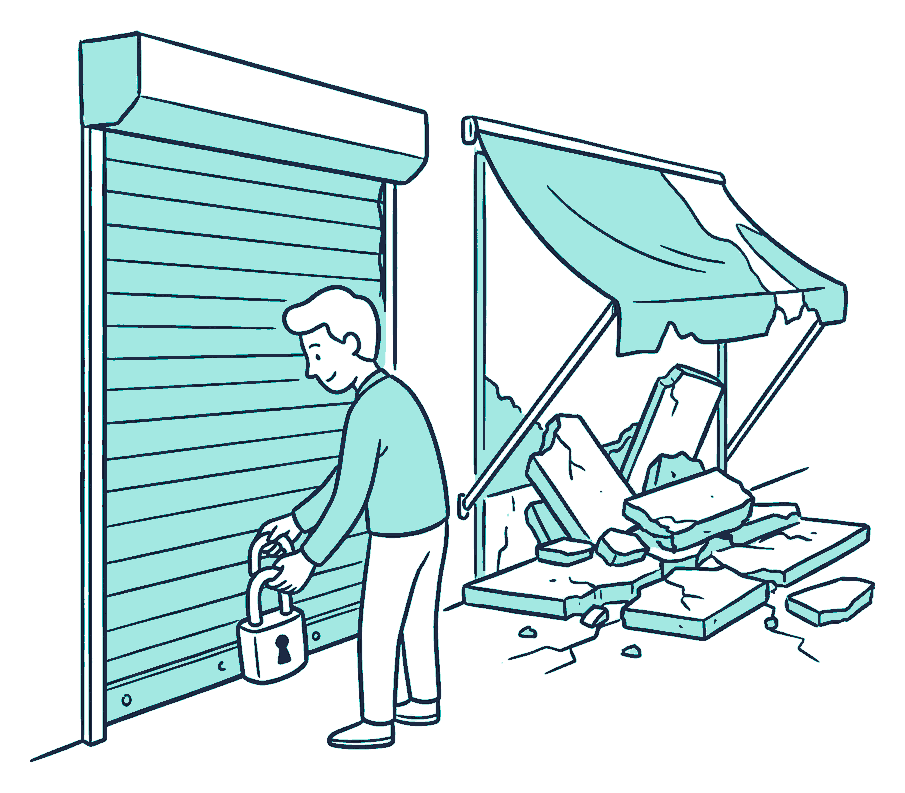
NZ-Specific Considerations
New Zealand's risk profile makes business interruption insurance particularly relevant, because the country sits on the boundary of the Australian and Pacific plates, EQC covers residential property while commercial losses fall to private insurance, Cyclone Gabrielle in 2023 shut businesses in Hawke's Bay and Tairawhiti for weeks, and geographic isolation stretches rebuild timelines to 12 to 24 months.
Earthquake risk. New Zealand sits on the boundary of the Australian and Pacific tectonic plates. The Canterbury earthquakes (2010 to 2011) and the Kaikoura earthquake (2016) demonstrated that major seismic events can shut businesses down for extended periods. EQC covers residential property, but commercial property and business losses are covered by private insurance only.
Weather events. Cyclone Gabrielle in 2023 caused widespread damage across the North Island, with many businesses in Hawke's Bay and Tairawhiti unable to trade for weeks or months. The increasing frequency of severe weather events makes flood and storm-related BI claims more likely.
Supply chain vulnerability. New Zealand's geographic isolation means that replacing specialised equipment or materials after a disaster often takes longer than it would in larger markets. This extends the interruption period and increases the importance of an adequate indemnity period.
Contractor shortages after major events. Following a widespread disaster, the demand for builders, electricians, and other trades far outstrips supply. This was a defining feature of the Canterbury recovery and is likely to repeat in any future large-scale event. Rebuild timelines of 12 to 24 months are common, even for relatively straightforward commercial premises.
COVID-19: What We Learned
COVID-19 exposed a core limitation of business interruption insurance in New Zealand, because most policies require physical damage to premises as a trigger and government-mandated lockdowns did not meet that threshold, so the vast majority of COVID-19 claims were declined. Some insurers have since added infectious disease extensions, typically capped and heavily conditioned.
The core issue: Most BI policies in NZ require physical damage to premises as a trigger. Government-mandated lockdowns, while devastating to revenue, did not constitute physical damage. The vast majority of BI claims related to COVID-19 were declined.
What changed:
- Business owners became far more aware of what their BI policies actually cover (and do not cover).
- Some insurers introduced limited infectious disease extensions, though these are typically capped at low limits and subject to significant conditions.
- The importance of reading policy wordings, rather than relying on assumptions about what is covered, became painfully clear.
The takeaway: BI insurance is designed for physical damage events, not pandemic risk. Businesses that want protection against government-mandated closures or pandemic-related revenue loss need to explore other risk management strategies, including cash reserves, diversified revenue streams, and potentially bespoke insurance products where available.
If you are reviewing your business insurance, our guide on self-employed insurance covers additional considerations for owner-operators who need both personal and business protection.
How to Get Business Interruption Insurance Right
Getting business interruption cover right in New Zealand comes down to five steps, calculating gross profit from your accountant's figures rather than an estimate, choosing an indemnity period based on a realistic worst case, aligning the perils in your material damage and BI policies, reviewing cover annually as revenue and fixed costs change, and working with a specialist adviser.
Calculate your gross profit accurately. Use your accountant's figures, not a rough estimate. Under-insurance is the most common problem in BI claims, and it can reduce your payout dramatically through average clauses.
Choose an adequate indemnity period. Think about the realistic worst case, not the best case. How long would it actually take to rebuild, refit, and return to full trading capacity? Add a margin for unexpected delays.
Ensure your material damage cover aligns. Your BI policy and material damage policy need to cover the same perils. If one excludes flood and the other includes it, you have a gap.
Review annually. Your revenue changes. Your fixed costs change. Your BI cover needs to keep pace. An annual review with your adviser ensures your insured gross profit and indemnity period remain appropriate.
Work with a specialist adviser. BI insurance is technical. The policy wording, the declarations, and the interaction with material damage cover all require careful attention. A licensed financial adviser who specialises in business insurance can identify gaps that a generalist might miss.
To protect your revenue properly, talk to a licensed adviser through QuoteHub about business interruption insurance and have your existing cover reviewed. Start a free, no-obligation check.
Frequently Asked Questions
Is business interruption insurance compulsory in New Zealand?
No. There is no legal requirement to hold business interruption insurance in New Zealand. However, some banks and lenders may require it as a condition of commercial lending, particularly where the loan is secured against business premises or assets. Even without a lender requirement, the financial risk of trading without BI cover is significant for most businesses with physical premises.
Can I get business interruption insurance without material damage cover?
In practice, no. Business interruption insurance is almost always sold as an extension to a material damage policy. The BI cover is triggered by events covered under the material damage section, so the two are intrinsically linked. You cannot typically purchase standalone BI cover.
Does business interruption insurance cover COVID-19 or future pandemics?
Standard BI policies in New Zealand require physical damage to premises as a trigger. Government-mandated closures without physical damage do not meet this threshold. Some insurers offer limited infectious disease extensions, but these are capped and subject to conditions. If pandemic risk is a concern, discuss specific options with your adviser.
How do I calculate the right amount of cover?
The insured amount should reflect your gross profit as defined in the policy (revenue minus specified variable costs), projected over your chosen indemnity period. Your accountant can help calculate this figure. It is critical to get this right, as under-insurance will result in a proportionally reduced claim through average clauses.
What is the difference between business interruption insurance and income protection insurance?
Business interruption insurance covers the business entity's lost revenue when premises are damaged. Income protection insurance covers an individual's personal income when they cannot work due to illness or injury. They protect different things and are not interchangeable. A business owner may need both.
How long does a business interruption claim take to settle?
BI claims are inherently more complex than straightforward property claims because they involve projecting what the business would have earned. Simple claims may be partially settled within weeks, with interim payments to keep the business afloat. Complex claims, particularly those involving large losses or disputed projections, can take six to twelve months or longer to fully resolve. Appointing a loss adjuster experienced in BI claims early in the process can help expedite settlement.
Disclaimer: This article is general information only and does not constitute personalised financial advice. Insurance products and availability change regularly. For advice tailored to your business, speak to a licensed financial adviser. Financial advice is provided by Craig Smith Business Services Limited, trading as Smiths Insurance & KiwiSaver, a licensed Financial Advice Provider (FSP712931). QuoteHub is a trading name. Henry Smith is a Financial Adviser (FSP1010699).
References
- Financial Markets Authority (FMA), Insurance guidance
- Business.govt.nz, Insurance for business
- Insurance Council of New Zealand (ICNZ)
- IRD, Business income tax
- Sorted.org.nz, Business insurance
- ACC New Zealand, What we cover
- Business.govt.nz, Running a business
- NZ Dental Association
Read the full insurance guides
Compare your cover with a licensed NZ adviser · free, no obligation.
Explore related pages: Life Insurance, Income Protection, Health Insurance, Trauma Insurance, Calculators.