Public vs Private Healthcare NZ: The Complete 2026 Comparison
Public healthcare in New Zealand is free or close to free at the point of care but rations elective treatment by clinical priority, so waits run weeks to months. Private treatment is scheduled in days to weeks and costs $20,000 to $30,000 for a hip or knee replacement, $3,500 to $6,000 an eye for cataract surgery and $500 to $1,500 for an MRI. Health insurance exists to meet that bill.
In short
- In the December 2025 quarter, 64.5% of patients received elective treatment within four months against a 95% government target (DPMC, Government Target 2, 18 June 2026, retrieved 18 August 2026).
- Going private without insurance costs $20,000 to $30,000 for a hip or knee replacement and $6,000 to $12,000 for a hernia repair, and a full hip journey through to rehabilitation can exceed $35,000.
- The public system applies no pre-existing condition exclusions, while private cover may exclude a pre-existing condition for one to three years.
New Zealand's healthcare system is a two-tier structure. On one side sits the publicly funded system, now operating under Te Whatu Ora (Health New Zealand), which provides universal access at little or no direct cost. On the other, a network of private hospitals, specialists, and clinics offers faster treatment for those who can pay or who hold health insurance.
For most Kiwis, the question is not whether the public system works. It does, and often very well. The question is whether the gaps in access, speed, and choice are significant enough to justify paying for private care. This guide lays out the facts so you can make that call with confidence.
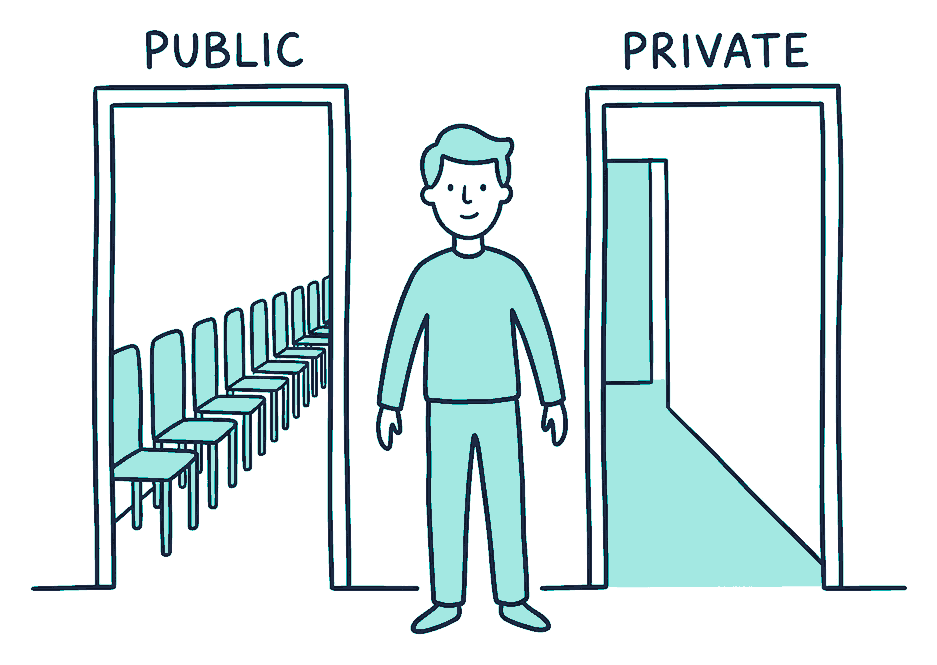
How the Public System Works in 2026
New Zealand's public healthcare system is funded through general taxation and administered by Te Whatu Ora. Every eligible resident can access GP visits (with a co-payment), hospital emergency departments, inpatient treatment, and elective surgery, all without direct charges at the point of care.
The system is built around clinical priority. If your condition is urgent or life-threatening, you will be treated quickly. Emergency departments, intensive care, and acute surgical services are world-class. The challenge lies in everything else: non-urgent specialist consultations, diagnostic imaging, and elective procedures such as joint replacements, cataract surgery, and hernia repairs.
Public system strengths
- Universal access. No one is turned away based on ability to pay.
- Acute and emergency care. NZ emergency departments averaged 105-minute wait times in 2023, shorter than Australia (159 minutes) and Canada (126 minutes).
- Equity focus. The system prioritises complex cases and high-need populations.
- No pre-existing condition exclusions. Your history does not affect your entitlement.
Public system pressures
The system faces real strain. Health NZ ended the 2023/24 financial year with a deficit of $722 million against a target surplus of $54 million (Health New Zealand, 3 December 2024, retrieved 18 August 2026). Workforce shortages, an ageing population, and rising costs are compressing capacity, and demand continues to outpace supply.
Elective Surgery Wait Times: The Numbers
Elective surgery wait times are the single biggest reason Kiwis look to private healthcare. In the December 2025 quarter, 64.5% of people were treated within four months, up from a September 2023 baseline of 62.0% but still far short of the 95% target (DPMC, *Government Target 2: Shorter wait times for elective treatment*, 18 June 2026, retrieved 18 August 2026). That leaves roughly a one-in-three chance of waiting longer than four months.
National elective wait time performance
Quarterly performance has moved within a narrow band rather than climbing steadily. The share of patients treated within four months ran 62.0% at the September 2023 baseline, 65.9% in September 2025 and 64.5% in the December 2025 quarter, against a government target of 95%. Every figure comes from the DPMC target factsheet, published 18 June 2026.
| Period | Patients treated within 4 months | Notes |
|---|---|---|
| September 2023 (baseline) | 62.0% | Starting point for current targets |
| October to December 2024 | ~59% | Dip reflecting long-term decline since 2017 |
| June 2025 | 63.9% | Improvement from electives boost programme |
| September 2025 | 65.9% | Previous quarter, per the DPMC target factsheet |
| December 2025 | 64.5% | Most recent published quarter; status "Feasible" |
| Target | 95% | Government target: 95% treated within four months |
The electives boost programme delivered 16,005 procedures by June 2025, which was 5,426 more than planned. By June 2025, no patient had waited over 700 days without a treatment plan. These are genuine improvements, but the 95% target remains a long way off.
What these numbers mean in practice
If you need a hip replacement, cataract surgery, or a non-urgent cardiac procedure, there is roughly a one-in-three chance you will wait longer than four months. For some specialties and regions, waits stretch well beyond six months.
Volumes are moving in the right direction even as the percentage measure wobbles: 51,513 people were treated from the elective waitlist in the December 2025 quarter, up from 46,841 a year earlier, and the 64.5% result is a 5.3 percentage point improvement on the same quarter a year before, though a 1.4 percentage point decline on the previous quarter (DPMC, *Government Target 2*, 18 June 2026, retrieved 18 August 2026).
Regional variation
Wait times vary significantly depending on where you live. While comprehensive regional breakdowns for 2025/26 are limited, available data shows the pattern clearly:
- Wellington (Capital and Coast): Emergency department performance improved to 61.0% treated within six hours by December 2025 (from 48.4% in July), but remains below target.
- Urban centres generally have more specialists and shorter waits for common procedures.
- Rural and provincial areas often face longer waits due to fewer surgeons and limited theatre capacity.
How the Private System Works
Private healthcare in New Zealand operates through private hospitals (such as Mercy, Southern Cross Hospitals, and others), specialist clinics, and private radiology and diagnostic centres. You can access private care in two ways: by paying out of pocket, or through health insurance.
Private system strengths
- Speed. Most private procedures can be scheduled within days or weeks, not months.
- Choice. You choose your specialist, your hospital, and your timing.
- Broader treatment options. Access to non-PHARMAC medicines and treatments not funded publicly.
- Comfort and convenience. Private rooms, flexible scheduling, and shorter overall recovery timelines.
Private system limitations
- Cost. Without insurance, a single procedure can cost tens of thousands of dollars.
- Selective patient base. Private providers focus on lower-complexity, elective work. Complex or emergency cases still go to public hospitals.
- Workforce overlap. Many specialists work across both systems, meaning private demand can reduce public capacity.
Cost of Going Private Without Insurance
Paying for private treatment in New Zealand without health insurance typically costs $20,000 to $30,000 for a hip or knee replacement, $3,500 to $6,000 per eye for cataract surgery, $6,000 to $12,000 for hernia repair, and $500 to $1,500 for an MRI scan. A full hip replacement journey from consultation to rehabilitation can exceed $35,000.
| Procedure | Approximate private cost (2026) |
|---|---|
| Hip replacement | $20,000 to $30,000 |
| Knee replacement | $20,000 to $30,000 |
| Cataract surgery (per eye) | $3,500 to $6,000 |
| MRI scan | $500 to $1,500 |
| Specialist consultation | $250 to $500 |
| Hernia repair | $6,000 to $12,000 |
| Colonoscopy | $2,000 to $4,000 |
| Gallbladder removal | $8,000 to $15,000 |
These costs add up quickly if you need multiple consultations, diagnostic tests, and a procedure. A hip replacement journey from initial consultation through to surgery and rehabilitation can easily exceed $35,000.
The Role of Health Insurance
Health insurance exists to bridge the gap between what the public system provides and what private care costs. In New Zealand, the two dominant health insurers are Southern Cross and nib, though several other providers also operate in the market.
What health insurance covers
Most comprehensive plans cover:
- Private hospital surgical procedures
- Specialist consultations and diagnostics
- Cancer treatment (including some non-PHARMAC drugs)
- Day-to-day benefits such as GP visits, dental, and optical (on higher-tier plans)
How the two main insurers compare on price for 2026
Health insurance premiums vary significantly based on age, excess level, and plan type. Comparing the two largest providers on the same profile, the difference is less about which is cheaper overall and more about where in the plan range you sit.
| Insurer | Premium positioning (couple, mid-age) | Excess discount | Financial strength |
|---|---|---|---|
| Southern Cross | Lower at entry-level plans, but the most expensive at the top of its range | ~25% | S&P A+ (Strong) |
| nib | Slightly higher at entry level, but the top of its range sits below Southern Cross | ~36% | S&P A (Strong) |
Financial strength grades above are those published on the Reserve Bank register of licensed insurers (retrieved 18 August 2026). Health insurance premiums have been rising faster than general inflation, reflecting the same pressures driving public system strain: an ageing population, rising healthcare costs, and increased utilisation.
Southern Cross vs nib: key differences
The gap between the two shows up in benefit caps rather than headline price. Southern Cross tops out at $600,000 of annual surgical cover against nib's $300,000, while nib allows up to $600,000 of non-PHARMAC drugs on Ultimate Health Max where most Southern Cross plans cap that at $10,000. All figures are published plan maximums rather than prices.
| Feature | Southern Cross | nib |
|---|---|---|
| Surgical cover | Up to $600,000/year on top plans | Up to $300,000/year surgical |
| Non-surgical hospital cover | Limited since 2020 changes | Up to $300,000/year |
| Non-PHARMAC drugs | Capped at $10,000/year (most plans) | Up to $600,000 on Ultimate Health Max |
| Pre-existing conditions | Covered after 3 years (UltraCare) | Varies by plan |
| Network | 900,000+ members, strong provider network | Growing network, strong add-on options |
| Best for | Stable, major-event protection | Broader hospital and non-surgical needs |
Southern Cross suits those who want reliable cover for major surgical events at a competitive price. nib tends to offer more generous non-surgical and non-PHARMAC benefits, which matters if you face a serious illness requiring newer medications.
Public vs Private: Side-by-Side Comparison
Public healthcare in New Zealand is free or close to free at the point of care but assigns your specialist, restricts medicines to PHARMAC-funded options, and takes weeks to months for elective procedures. Private care schedules treatment in days to weeks, lets you choose the surgeon and hospital, and opens access to non-PHARMAC options, though pre-existing conditions may be excluded for one to three years.
| Factor | Public (Te Whatu Ora) | Private |
|---|---|---|
| Cost to patient | Free or minimal co-pay | An annual premium (insured) or thousands per procedure (uninsured) |
| Wait times | Weeks to months for electives | Days to weeks |
| Choice of specialist | Assigned based on availability | You choose |
| Treatment options | PHARMAC-funded medicines only | Access to non-PHARMAC options |
| Acute/emergency care | Excellent | Not applicable (diverts to public) |
| Pre-existing conditions | No exclusions | May be excluded for 1 to 3 years |
| Quality of outcomes | Strong equity, good population-level outcomes | Good individual outcomes for elective work |
| Comfort | Shared wards typical | Private rooms standard |
When Private Healthcare Matters Most
Private healthcare matters most in New Zealand for people over 40, those with a family history of cancer or serious illness, the self-employed, residents of regions with long public waits, and anyone who places real value on choosing their surgeon and timing. Kiwis under 30 in good health with no dependents often manage well on public care alone.
You should seriously consider private access if:
- You are over 40. The likelihood of needing elective procedures increases with age, and public wait times hit hardest for conditions common in middle age and beyond.
- You have a family history of cancer or serious illness. Access to non-PHARMAC drugs and faster diagnostics can make a material difference in treatment outcomes.
- You are self-employed or a business owner. Extended wait times for surgery mean extended time away from income. Private care lets you schedule around your commitments.
- You live in a region with long public waits. If your local hospital is under particular pressure, private access provides a reliable alternative.
- You value choice. Choosing your surgeon, your hospital, and your timing is important to some people, and that is a perfectly valid reason.
You may not need private access if:
- You are under 30, in good health, and have no dependents or significant financial obligations.
- You have access to a strong employer-subsidised health plan.
- Your primary concern is emergency or acute care, which the public system handles well.
Who Benefits Most from Private Healthcare?
Four groups gain the most from private healthcare access in New Zealand: families with school-age children needing ENT and orthopaedic care, working professionals aged 40 to 65, people with chronic conditions requiring ongoing specialist monitoring, and rural New Zealanders where public specialist access is limited. Faster diagnostics and broader medication options drive most of the benefit.
Families with school-age children. Faster access to ear, nose, and throat (ENT) procedures, orthopaedic consultations, and diagnostic imaging keeps kids healthy and in school.
Working professionals aged 40 to 65. This is the demographic most likely to need elective procedures and least able to afford months off work waiting for public treatment.
People with chronic conditions. Ongoing specialist access, diagnostic monitoring, and broader medication options provide better management of long-term health issues.
Rural New Zealanders. Where public specialist access is limited, private options (including telehealth consultations and travel to private facilities) can fill critical gaps.
Making the Decision: A Practical Framework
Choosing between public and private care in New Zealand rests on three questions: what a six-month wait for surgery would cost you in lost income and quality of life, whether you could cover a $20,000 to $30,000 procedure from savings, and whether your age, family history and occupation create above-average risk.
- What would a six-month wait for surgery cost me? Consider lost income, reduced quality of life, and the impact on your family.
- Could I cover a $20,000 to $30,000 procedure from savings? If not, insurance provides certainty.
- Does my current life stage and health profile create above-average risk? Age, family history, and occupation all factor in.
For many Kiwis, the answer points toward holding at least a core surgical health insurance plan. The cost is meaningful, but so is the protection it provides.
Frequently Asked Questions
Is private healthcare in NZ better quality than public?

Not necessarily. New Zealand's public hospitals lead in acute care, complex surgery, and equitable outcomes. Private care excels in speed, comfort, and choice for elective procedures. Research consistently shows that public systems achieve better population-level health outcomes, while private care offers advantages for individual convenience and access.
Can I use both public and private healthcare?
Yes. Many Kiwis use the public system for GP visits, emergency care, and prescriptions while holding health insurance for specialist and surgical access. The two systems are complementary, not mutually exclusive.
Are public hospital wait times getting better?
There has been genuine improvement. The proportion of patients treated within four months rose from 62.0% in September 2023 to 65.9% in September 2025. However, this is still well below the 95% target, and progress is gradual.
How much does health insurance cost in NZ?
It depends on the insurer, the plan level, the ages of the people covered, and the excess you choose. Age is the strongest driver, and a higher excess reduces the premium noticeably. Premiums rise with age and have been increasing faster than general inflation, so the figure you are quoted today is not the figure you will pay in five years. An adviser can compare the major insurers on identical cover so the comparison is like for like.
Does health insurance cover pre-existing conditions?
Most insurers exclude pre-existing conditions for a stand-down period, typically one to three years. Southern Cross's UltraCare plan covers pre-existing conditions after three years. This is one reason to take out cover earlier in life, before conditions develop.
What is not covered by the public system?
The public system does not cover most dental care (for adults), optical care, many non-urgent specialist consultations without a long wait, non-PHARMAC medicines, and elective cosmetic procedures. Some newer cancer treatments and surgical techniques are also only available privately.
Should I choose a high excess to lower my premium?
A higher excess can reduce premiums by 25 to 36%. This works well if you are generally healthy and want cover mainly for significant events. However, it means paying more out of pocket for smaller claims, so consider your financial position carefully.
References
- Ministry of Health NZ, Health system overview
- Financial Markets Authority (FMA), Insurance guidance
- Sorted.org.nz, Health insurance
- Insurance & Financial Services Ombudsman (IFSO)
- MoneyHub NZ, Health insurance
- Cancer Society of New Zealand
- ACC New Zealand, What we cover
- IRD, Income tax rates
- Health New Zealand: Health NZ end-of-year deficit confirmed (3 December 2024)
- DPMC: Government Target 2, Shorter wait times for elective treatment (18 June 2026)
- Reserve Bank of New Zealand: Register of licensed insurers (retrieved 18 August 2026)
- Te Whatu Ora. Health System Indicator Framework: Planned Care. 2025/26 reporting.
- Te Whatu Ora. Annual Report and Financial Statements. 2025.
- MoneyHub NZ. Health Insurance Comparison. 2026.
- GetInsured NZ. Health Insurance Quotes and Analysis. 2026.
- RBNZ Insurance Data. Hospital and Health Revenue Statistics. 2025/26.
- Mercer. 2026 Global Medical Trends Survey: New Zealand.
- Southern Cross Health Insurance. Product Disclosure Statements. 2025/26.
- nib New Zealand. Product Disclosure Statements. 2025/26.
Disclaimer: This article is for informational purposes only and does not constitute financial or medical advice. Financial advice is provided by Craig Smith Business Services Limited, trading as Smiths Insurance & KiwiSaver, a licensed Financial Advice Provider (FSP712931). QuoteHub is a trading name. Henry Smith is a Financial Adviser (FSP1010699). Health insurance products are provided by third-party insurers. Always consult a licensed financial adviser and your healthcare provider before making decisions about your health cover. Information is current as at March 2026 and may change.
Read the full insurance guides
Compare your cover with a licensed NZ adviser · free, no obligation.
Explore related pages: Life Insurance, Income Protection, Health Insurance, Trauma Insurance, Compare Insurance NZ.