Stepped vs Level Premiums NZ: Which Structure Saves You More?
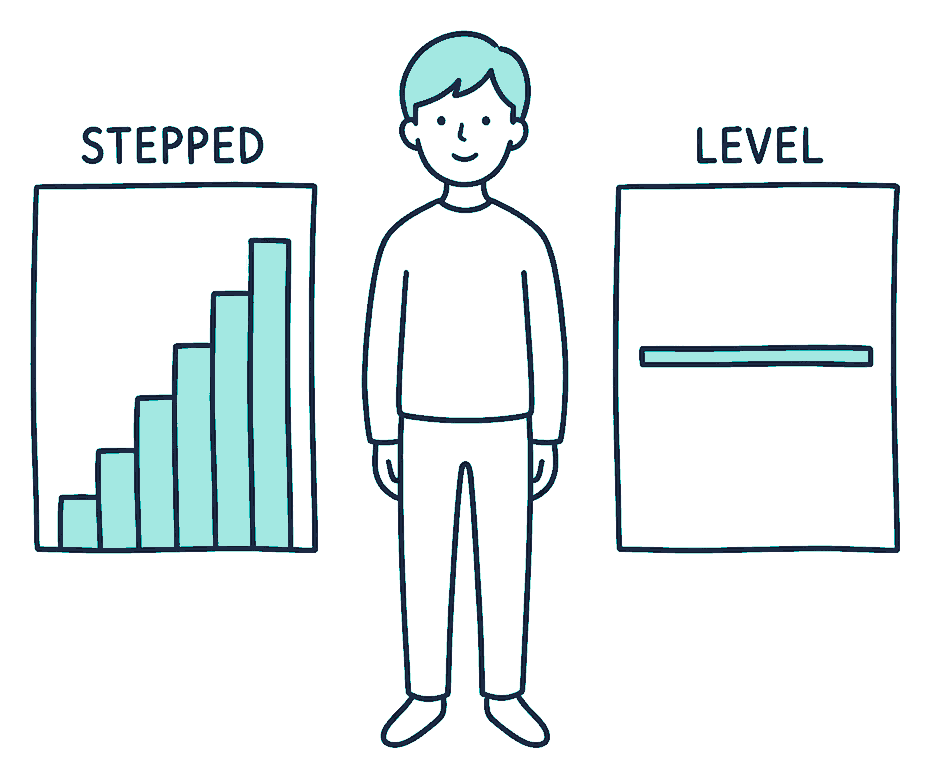
Stepped premiums in New Zealand start lower and are repriced against your age every year, typically rising 5% to 15% annually and steepening from your mid-40s. Level premiums are fixed at your entry age and hold that rate for the policy term. The cumulative crossover, the point at which the level holder has paid less in total, falls around age 48 to 55 on New Zealand market data.
In short
- Stepped increases steepen with age, running about 3% to 6% a year between 25 and 35 and 10% to 15% a year between 55 and 65 on indicative New Zealand insurer data.
- A policy started at 30 crosses over around age 48 to 53, and one started at 35 crosses over around age 50 to 55.
- Level premiums are not frozen outright: insurers can still apply CPI or portfolio-wide adjustments of roughly 2% to 4%, but the age-based component is locked at your entry age.
Stepped premiums are recalculated against your age every year and typically rise 5% to 15% annually in New Zealand; level premiums are fixed at your entry age and do not move with age at all. The choice applies to life insurance, income protection and trauma cover alike, and over the life of a policy it can be worth tens of thousands of dollars.
This guide breaks down how each structure works, when the crossover point occurs, and which option makes the most sense depending on your age, budget, and how long you expect to hold cover.
How Stepped Premiums Work
Stepped premiums start low and increase every year as you age, because the insurer recalculates the rate annually against your current age and the rising statistical risk of a claim. In New Zealand the annual increase typically runs 5% to 15% depending on age bracket, and the increases accelerate sharply from your mid-40s onward.
Key characteristics:
- Lowest possible starting cost
- Premiums increase every year, typically by 5% to 15% depending on your age bracket
- Increases accelerate sharply from your mid-40s onward
- No lock-in benefit. You are effectively buying one year of cover at a time, priced at your current age
Example: For a 35-year-old woman with $250,000 of life cover, a stepped premium starts at the lowest point available and then climbs every year. By age 50 it has risen substantially, by age 65 it is far higher again, and by age 80 it can become genuinely unaffordable. The sum insured has not changed at any point. Only your age has.
The appeal is obvious at the start: stepped premiums are cheap when you are young. But the compounding annual increases mean that, over time, the total amount you pay can be significantly more than what you would have paid on a level structure.
How Level Premiums Work
Level premiums are set at the start of the policy using your age at that time and stay fixed for the life of the policy, typically to age 80 or 100 depending on the insurer and product. New Zealand insurers may still apply CPI or portfolio-wide adjustments, but the age-based component is locked in, so you keep paying a younger rate.
Key characteristics:
- Higher starting cost compared to stepped
- Premium stays the same each year (in nominal terms)
- Insurer may still apply CPI adjustments or portfolio-wide rate changes, but the age-based component is locked in
- You benefit from paying a "younger" rate for your entire policy term
Example: The same 35-year-old woman with $250,000 of life cover would start noticeably higher on a level basis than she would on stepped. That rate then stays the same at age 50, at 65, and beyond.
Level premiums cost more upfront, but because they do not increase with age, the total amount paid over a long holding period is often substantially less.
Annual Increase Rates for Stepped Premiums
Stepped premium increases are not flat, they steepen with age along the mortality and morbidity curves. New Zealand insurer data puts typical annual rises at 3% to 6% between ages 25 and 35, 5% to 8% from 35 to 45, 8% to 12% from 45 to 55, and 10% to 15% from 55 to 65.
Here is what typical annual increases look like across different age brackets. A stepped premium rises 3% to 6% a year between 25 and 35, 8% to 12% a year between 45 and 55, and 12% to 18% a year between 65 and 80. These are indicative ranges drawn from New Zealand insurer data rather than a published schedule, and your own figure depends on the insurer, the product, your gender and your smoker status.
| Age bracket | Typical annual stepped increase |
|---|---|
| 25 to 35 | 3% to 6% per year |
| 35 to 45 | 5% to 8% per year |
| 45 to 55 | 8% to 12% per year |
| 55 to 65 | 10% to 15% per year |
| 65 to 80 | 12% to 18% per year |
These are indicative ranges. Actual increases depend on your insurer, product type (life, trauma, income protection), gender, and smoker status. The important point is that increases are not linear. They accelerate, and this is what catches many policyholders off guard in their 50s and 60s.
Crossover Point Analysis
The crossover point is the age at which the cumulative total paid on a stepped policy overtakes the cumulative total paid on a level policy. On New Zealand market data a policy started at 30 crosses over around age 48 to 53, and one started at 35 crosses over around age 50 to 55. Beyond 15 to 20 years of cover, level almost always costs less.
When does the crossover happen?
Based on NZ market data, the crossover typically occurs:
- Policy started at age 25: Crossover in the early to mid-50s
- Policy started at age 30: Crossover around age 48 to 53
- Policy started at age 35: Crossover around age 50 to 55
- Policy started at age 41: Crossover around age 52 to 55
The exact crossover depends on the insurer's rate tables, but the pattern is consistent: if you hold your policy for more than 15 to 20 years, level premiums almost always work out cheaper in total.
Total cost comparison: $200,000 life cover, female, non-smoker, starting age 25
This table shows which structure is ahead on cumulative cost over various time horizons, for $200,000 of life cover taken by a female non-smoker at age 25. Stepped is still cheaper in total at 10 and 15 years, the advantage flips to level at 20 years, and by 30 years, at age 55, the level holder is well ahead. The positions are relative, drawn from representative New Zealand insurer quotes rather than published prices.
| Holding period | Age at end | Cheaper structure | Size of the gap |
|---|---|---|---|
| 10 years | 35 | Stepped | Clear, stepped is still well under the level rate |
| 15 years | 40 | Stepped | Narrowing as the crossover approaches |
| 20 years | 45 | Level | Small, but the advantage has flipped |
| 25 years | 50 | Level | Wide, stepped increases are now compounding |
| 30 years | 55 | Level | Very wide, and widening every year |
Over a full working lifetime (age 25 to 80), the level premium holder in this scenario pays dramatically less in total than the stepped premium holder. That is an extraordinary difference from a single structural decision made at age 25.
Total cost comparison: $250,000 life cover, female, non-smoker, starting age 35
Running the same comparison from a later entry age, $250,000 of life cover for a female non-smoker starting at 35, moves the crossover out by only a few years. Stepped is comfortably cheaper over 10 years and narrowly cheaper over 15, level is clearly cheaper by 20 years, and the gap is very wide by 30 years, at age 65. These are relative positions on New Zealand market data, not quoted prices.
| Holding period | Age at end | Cheaper structure | Size of the gap |
|---|---|---|---|
| 10 years | 45 | Stepped | Clear, stepped is comfortably cheaper in total |
| 15 years | 50 | Stepped | Narrow, the crossover is close |
| 20 years | 55 | Level | Clear and growing |
| 25 years | 60 | Level | Wide |
| 30 years | 65 | Level | Very wide |
Total cost comparison: stepped vs level, starting age 41
For cover started at 41, the stepped rate begins well below the level rate, at less than half of it, while the level rate never moves from its age-41 setting. The two are almost identical by 51, and by 56 the stepped rate is materially above level and widening every year. The table tracks relative positions from New Zealand insurer rate tables rather than dollar premiums.
| Age | Stepped premium | Level premium |
|---|---|---|
| 41 | Well below the level rate | Fixed at the age-41 rate |
| 46 | Rising, still below level | Unchanged |
| 51 | Almost identical to level | Unchanged |
| 56 | Materially above level | Unchanged |
| 61 | Far above level | Unchanged |
At age 41, the stepped premium is less than half the level premium. By age 51, they are almost identical. By age 56, the stepped premium is more than 50% higher than level, and the gap only widens from there.
When Level Premiums Win
Level premiums win in New Zealand when cover is needed for 15 years or more, when you are under 45 and in good health, when cost certainty matters for budgeting, when the need runs 20 to 30 years such as raising children or income protection to retirement, and when future insurability is a concern.
- You plan to hold cover for 15 years or more. The crossover point means level becomes cheaper in total over longer holding periods.
- You are under 45 and in good health. Locking in a level rate while young gives you the biggest long-term advantage.
- You want cost certainty. Knowing your premium will not change makes budgeting simpler, especially heading into your higher-earning years.
- You are covering a long-term need. If you need life cover until your children are financially independent (which could be 20 to 30 years away), or income protection until retirement, level is almost always the better structure.
- You are concerned about future insurability. If your health changes, you may not be able to switch from stepped to level later without new underwriting. Locking in level now avoids that risk.
When Stepped Premiums Make Sense
Stepped premiums make sense in four situations, being when cover is only needed for 5 to 10 years such as a short-term mortgage, when a tight budget means level premiums would mean going without cover entirely, when your sum insured is planned to fall as the mortgage shrinks, and when you are over 55 taking out a new New Zealand policy.
- You only need cover for a short period. If you need life insurance for 5 to 10 years (for example, to cover a short-term mortgage or until your savings reach a target), stepped is cheaper.
- Your budget is tight right now. If paying higher level premiums would mean going without cover entirely, stepped gets you insured today. Some cover is always better than none.
- You expect your cover needs to decrease. If you plan to reduce your sum insured as your mortgage shrinks and your wealth grows, the declining need can offset the rising stepped cost.
- You are over 55 and taking out a new policy. At older ages, level premiums are priced very high to compensate for the shorter period over which the insurer can spread the risk. Stepped may be more practical for a shorter remaining cover period.
Hybrid Options
Hybrid premium structures blend stepped and level, and a minority of New Zealand insurers offer them. Common forms are level premiums for a fixed term of 10 or 15 years that then convert to stepped, splitting benefits so life cover sits on level and trauma on stepped, and capped stepped policies that limit the annual increase.
Common hybrid approaches
- Level for a fixed term, then stepped. Some policies offer level premiums for 10 or 15 years, after which they convert to stepped. This gives you cost certainty during your peak earning years and lower costs early on.
- Partial level, partial stepped. You can sometimes structure different benefits on different premium bases. For example, life cover on level premiums and trauma cover on stepped, reflecting the different likely holding periods for each.
- Capped stepped. A small number of products cap the annual stepped increase at a set percentage, reducing the risk of extreme jumps in later years.
Hybrid structures can be a good middle ground if you want some of the budget friendliness of stepped without accepting the full long-term cost risk.
What Actually Drives Your Premium
Age, gender, smoker status and the sum insured are the four levers that move a New Zealand life insurance premium the most, and age is by far the strongest. On a stepped structure the rate is repriced against your age every year, so the same policy on the same person costs progressively more; on a level structure the age used is frozen at the day you applied, which is why the entry age matters so much.
Relative premium level by age and gender (standalone life cover, non-smoker)
Age and gender set the base rate before any structure is chosen. A 25-year-old female sits at the lowest relative level in the table and a 50-year-old male at the highest, with a male of 30 rated slightly above a female of the same age. On New Zealand rate tables the premium roughly doubles every 10 years, so a 50-year-old male pays about four to five times a 30-year-old male.
| Age / Gender | Relative premium level | What is driving it |
|---|---|---|
| Female, 25 | Lowest | Minimal mortality risk, and the cheapest point at which to lock in a level rate |
| Female, 30 | Low | Risk still low; adding TPD or trauma to the policy changes the total more than the sum insured does |
| Male, 30 | Low | Slightly higher mortality risk than a female of the same age |
| Male, 40 | Moderate | Mortality risk climbing, and stepped increases begin to bite each year |
| Male, 50 | Highest of these ages | Risk rising steeply, and level rates are also priced high at this entry age |
The relative level varies between insurers, but the pattern is consistent: the premium roughly doubles every 10 years of age. A 50-year-old male pays approximately four to five times what a 30-year-old male pays for the same cover.
How the two structures compare by entry age
Entry age sets both structures at once. At 30 the stepped rate is the lowest starting point of the three and the level rate sits just above it. At 50 the stepped rate is both the highest starting point and the fastest rising, and the level rate is the highest of all, because the insurer has fewer years over which to spread the risk. These are starting-year positions only.
| Starting age | Stepped starting position | Level position (fixed for the term) |
|---|---|---|
| 30 | Lowest starting point of the three, and it rises every year | Higher than stepped at the outset, then never moves |
| 40 | Higher starting point than at 30 | Higher again, reflecting the older entry age |
| 50 | Highest starting point, and it rises fastest | Highest of the three, because the insurer has fewer years to spread the risk |
These describe starting-year positions only. The stepped premium increases every year from there. The level premium stays where it started.
Decision Framework: Choosing by Age and Cover Duration
Choosing between stepped and level in New Zealand comes down to age and how long cover is needed. Under 30 and needing cover for 20 years or more makes the strongest case for level, while 5 to 10 years of cover points to stepped at any age. Between 30 and 50, level wins for anything beyond 10 years.
| Your age | Cover needed for 5 to 10 years | Cover needed for 10 to 20 years | Cover needed for 20+ years |
|---|---|---|---|
| Under 30 | Stepped | Level or hybrid | Level (strongest case) |
| 30 to 40 | Stepped | Level | Level |
| 40 to 50 | Stepped or hybrid | Level | Level |
| 50 to 60 | Stepped | Hybrid | Level if affordable |
| Over 60 | Stepped | Stepped or hybrid | Case by case |
Additional decision factors
- Can you convert later? Many NZ insurers allow you to convert from stepped to level premiums without new medical underwriting. This gives you an exit strategy if you start on stepped but later want to lock in. However, the level rate you convert to will be based on your age at conversion, not your original age, so you lose the benefit of locking in younger.
- Income trajectory. If your income is expected to grow significantly, starting on level makes sense because the premium will become a smaller percentage of your income over time.
- Inflation and CPI. Even level premiums may be adjusted for inflation or insurer-wide rate changes. Factor in 2% to 3% for CPI-linked adjustments on top of the base premium.
- Review regularly. Whichever structure you choose, review your cover every two to three years. Your needs change as your mortgage shrinks, your savings grow, and your family situation evolves.
Frequently Asked Questions
Can I switch from stepped to level premiums later?
Yes. Most NZ insurers offer a conversion option that allows you to move from stepped to level without new medical underwriting. The catch is that your new level premium will be based on your age at the time of conversion, which will be higher than if you had started on level from the beginning.
Do level premiums ever increase?
The age-based component is fixed, but insurers can apply CPI (inflation) adjustments and portfolio-wide rate changes. In practice, this means level premiums may increase by 2% to 4% per year in some years, but this is far less than the 8% to 15% annual increases typical of stepped premiums from your mid-40s onward.
Is the crossover point the same for all types of cover?
The crossover timing is similar across life insurance, income protection, and trauma cover, but the exact point varies. Income protection tends to have a slightly earlier crossover because the claims risk increases more steeply with age. Life insurance crossovers tend to occur a few years later.
Are level premiums available for all types of insurance?
Level premiums are available for life insurance, income protection, trauma cover, and total permanent disability (TPD) cover with most NZ insurers. They are less common for health insurance, which is typically priced on a community or age-banded basis rather than a stepped/level structure.
What if I can only afford stepped premiums right now?
Take the cover on stepped premiums. Being insured on a stepped basis is far better than being uninsured because level premiums are too expensive. You can always convert to level later, and in the meantime you have protection in place.
Does smoking status affect the crossover point?
Yes. Smokers pay significantly higher premiums on both structures (often three to four times more than non-smokers). However, the relative advantage of level over stepped remains the same. If anything, the case for level is stronger for smokers because the absolute dollar savings over time are larger.
Should I choose level premiums for my mortgage protection?
It depends on how long your mortgage term is. If you have 25 to 30 years remaining, level premiums will almost certainly save you money. If you are within 10 years of paying off your mortgage, stepped may be more cost-effective. Also consider whether a decreasing cover option (where the sum insured reduces in line with your mortgage balance) might be a better fit than choosing between stepped and level on a fixed sum.
References
- Financial Markets Authority (FMA), Insurance guidance
- ACC New Zealand
- Sorted.org.nz, Insurance guides
- Insurance & Financial Services Ombudsman (IFSO)
- Consumer Protection NZ
- ACC New Zealand, What we cover
- Financial Markets Authority (FMA)
- LifeDirect NZ. "Stepped vs Level Premiums: How to Choose." Accessed March 2026.
- Sorted.org.nz. "Understanding Life Insurance Costs." Accessed March 2026.
- MoneyHub NZ. "Life Insurance Premium Comparison." Accessed March 2026.
- Partners Life. "Premium Structure Options." Accessed March 2026.
- AIA New Zealand. "Understanding Your Premium Options." Accessed March 2026.
- Financial Markets Authority (FMA). "Insurance Guidance for Consumers." Accessed March 2026.
Disclaimer: This article is for informational purposes only and does not constitute financial advice. QuoteHub connects New Zealanders with licensed financial advisers. Our Financial Services Provider (FSP) number is 712931. Always seek personalised advice from a licensed financial adviser before making insurance decisions.
Read the full insurance guides
Compare your cover with a licensed NZ adviser · free, no obligation.
Explore related pages: Life Insurance, Income Protection, Health Insurance, Trauma Insurance, Ongoing Protection.