TPD Insurance NZ: What Total and Permanent Disability Cover Pays
TPD insurance in New Zealand pays a single lump sum if illness or injury leaves you permanently unable to work again. QuoteHub flags that nothing provides it by default, so the cover exists only if you or an employer arranged it. The occupation definition decides most claims: AIA and Chubb both write any-occupation wordings that can decline if you could earn more than 25% of your former income in other work.
In short
- An own-occupation definition tests the job you trained for, while an any-occupation definition asks whether you could do any work you are reasonably suited to that pays more than 25% of your prior earnings (AIA Living TPD policy wording, retrieved 18 August 2026).
- Fidelity Life's current LifeProtect Permanent Disability Cover wording uses a single own-occupation definition and contains no accelerated option (Fidelity Life policy wording, retrieved 18 August 2026).
- ACC covers accidental injury only, so a stroke, cancer or degenerative illness that permanently ends your working life attracts no ACC income support (ACC, Financial support for permanent injury, retrieved 18 August 2026).
TPD insurance pays a single lump sum if illness or injury leaves you permanently unable to work again. It is bought individually from a life insurer in New Zealand, and the amount is yours to use as you choose: clearing the mortgage, modifying a house for a wheelchair, funding rehabilitation, or replacing the income your household has permanently lost. One word in the policy decides most claims, and it is the occupation definition.
That word is why two people with the same condition and the same sum insured can get opposite answers. An own occupation definition asks whether you can return to the job you were trained for. An any occupation definition asks whether you could do any work at all that your education, training or experience fits you for, which is a far harder test to fail and therefore a far harder claim to win. The section below sets out both, and the trade-off is the single most consequential thing on this page.
ACC does not close this gap. It covers injuries caused by accidents and pays nothing for illness, so a stroke, a cancer or a degenerative disease that permanently ends your working life attracts no ACC income support at all. TPD insurance and income protection are the two products that answer that exposure, and they answer different halves of it: income protection replaces earnings while you are off work, TPD pays out once the position is permanent. Life insurance pays your family after you die; TPD pays you while you are alive and cannot earn.
What Does TPD Insurance Cover?
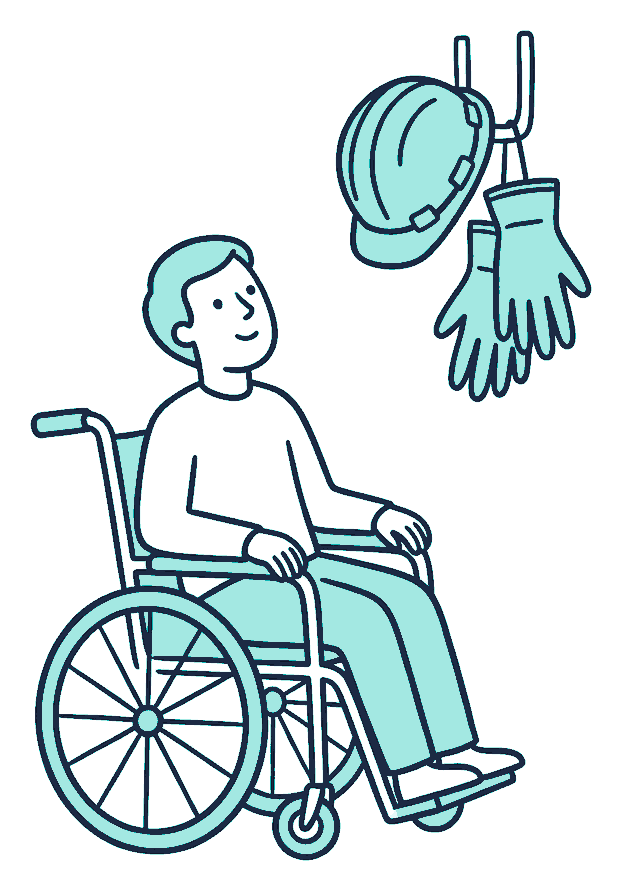
TPD insurance in New Zealand pays a tax-free lump sum if you suffer a total permanent disability that prevents you from ever returning to work. The payment is typically used to clear a mortgage and other debts, fund home modifications such as wheelchair access, cover ongoing medical and rehabilitation costs, and replace lost future income for your family.
Common uses for a TPD payout include:
- Paying off the mortgage and other debts
- Funding home modifications (wheelchair access, bathroom adaptations)
- Covering ongoing medical and rehabilitation costs
- Replacing lost future income
- Supporting your family's living costs
The key word is permanent. TPD insurance is not designed for temporary disabilities or conditions you are expected to recover from. Those situations are covered by income protection or ACC (for accident-related injuries).
Nothing in New Zealand Gives You TPD Cover by Default
This is where New Zealand differs from Australia, and the difference catches people out. Australian superannuation funds commonly attach life and TPD insurance to a member's account automatically. KiwiSaver does no such thing: it is a retirement savings scheme with no insurance component, and New Zealand has no mandatory workplace scheme sitting behind it: the Retirement Commission describes KiwiSaver as a "Tier 3" benefit and records that "there is no Tier 2 scheme in Aotearoa New Zealand" (Te Ara Ahunga Ora Retirement Commission).
The practical consequence is that TPD cover in New Zealand only exists if someone arranged it. That is either you, through a life insurer and usually an adviser, or your employer through a group scheme, which some insurers write for workforces above a minimum number of lives. If neither has happened, you have no TPD cover, regardless of how long you have been contributing to KiwiSaver.
The Critical Difference: Own Occupation vs. Any Occupation
The definition of disability in a New Zealand TPD policy decides whether a claim is approved or declined. An own-occupation definition pays if you are permanently unable to perform the duties of your specific job, and costs more. An any-occupation definition pays only if you cannot work in any job reasonably suited to your education, training or experience.
Own Occupation
Under an own-occupation definition, you qualify for a TPD payout if you are permanently unable to perform the duties of your specific occupation. Even if you could theoretically do a different, less demanding job, your claim would still be valid.
Example: A surgeon who suffers permanent nerve damage in both hands can no longer operate. Under an own-occupation policy, this would likely qualify as a TPD claim, even though the surgeon could potentially work in a teaching or consulting role.
Any Occupation
Under an any-occupation definition, you qualify only if you are permanently unable to work in any occupation that is reasonably suited to your education, training, or experience. This is a much higher bar to clear.
Example: The same surgeon with nerve damage may not qualify under an any-occupation policy if the insurer determines they could work in medical education, research, or administration.
What the Actual NZ Wordings Say
The "any occupation" test is narrower than the plain words suggest, and the New Zealand wordings share a specific mechanism: the alternative work only counts if it would pay you above a threshold, and that threshold is low. AIA and Chubb both set it at 25% of your pre-disability earnings. If a job exists that you could do and that pays more than a quarter of what you used to earn, an any-occupation policy can decline.
| Insurer and product | Own occupation available? | What the wording actually requires |
|---|---|---|
| AIA NZ: AIA Living TPD | Yes, alongside any occupation | Any occupation: unable to work for three consecutive months and unlikely ever to work "in any occupation or engage in any other gainful employment for which he or she may be reasonably suited by education, training or experience, which would pay remuneration at a rate greater than 25%" of prior earnings (AIA Living TPD policy wording) |
| Chubb Life NZ: Complete Disablement Cover, Assurance Extra | Yes, occupation classes 1–3, for an extra premium | Chubb states plainly that "there is an extra premium payable for 'own' occupation". Any occupation applies to classes 1–4 and uses the same 25%-of-prior-income threshold (Chubb, Complete Disablement Cover) |
| Fidelity Life: LifeProtect Permanent Disability Cover | Own occupation only | The current wording contains a single employed definition, tested against "their own occupation", meaning "the field of work in which the insured person has trained and was engaged immediately before becoming totally and permanently disabled" (Fidelity Life, LifeProtect Permanent Disability Cover) |
| Partners Life: TPD Cover | Yes, for an additional premium | "You can choose your own occupation definition for an additional premium." Note also that "the definition of TPD changes from the ability to work to a non-occupational definition once you reach age 65" (Partners Life, TPD overview) |
Two things follow from this table that most summaries miss. First, own occupation is not universally available: it is priced as an extra and, at Chubb, restricted to the lighter occupation classes, which is the opposite of what intuition suggests, because the people who most need it are the ones doing physical work. Second, Chubb's direct-to-consumer Life & Living range carries no TPD benefit at all: TPD only exists in the adviser-distributed Assurance Extra suite. If you bought cover online without advice, check whether you actually hold it.
Our recommendation: if your occupation involves specialised physical or technical skills, own-occupation cover is worth the extra cost, and it is worth checking that your insurer still offers it on the product you are being quoted. The difference looks small until the 25% test is applied to you.
How TPD Claims Work
A TPD claim takes longer than a life insurance claim because the insurer must establish that the disability is permanent. Most New Zealand policies require a waiting period of six months or more after the disability occurs, followed by specialist medical reports, assessment against the own or any occupation definition, and payment of the full sum insured as a tax-free lump sum.
Step-by-Step Claims Process
- Notification. You (or your representative) notify the insurer that you intend to make a TPD claim.
- Waiting period. Most policies require a waiting period of six months or more after the disability occurs. This allows time for medical treatment and assessment to confirm the condition is unlikely to improve.
- Medical evidence. You will need specialist medical reports confirming the nature and permanence of your disability. For example, an ophthalmologist for sight loss, a neurologist for brain injury, or an orthopaedic specialist for limb loss.
- Assessment. The insurer reviews the medical evidence against your policy definition (own or any occupation) to determine whether the claim meets the threshold.
- Payment. If the claim is approved, the full sum insured is paid as a tax-free lump sum. Your policy then ends.
What Triggers a TPD Claim?
Policies list the specific conditions and functional impairments that qualify, and while the detail varies by provider, the categories are consistent across New Zealand insurers. They are loss of limbs or sight, an inability to perform two or more activities of daily living such as bathing, dressing or mobility, permanent cognitive impairment requiring full-time supervision, an inability to work under the policy's occupation test, and partial disablement, which may attract a reduced payout rather than the full sum insured.
| Category | Description | Examples |
|---|---|---|
| Loss of limbs or sight | Total, permanent loss of sight in both eyes, loss of two or more limbs, or loss of sight in one eye plus one limb | Workplace accident, diabetic complications, severe infection |
| Activities of daily living (ADL) | Inability to perform two or more ADLs without assistance | Bathing, dressing, eating, toileting, mobility |
| Cognitive impairment | Permanent, irreversible cognitive deterioration requiring full-time supervision | Severe traumatic brain injury, advanced dementia, certain strokes |
| Inability to work | Permanently unable to perform own occupation or any occupation (depending on policy) | Chronic progressive illness, severe mental health conditions, degenerative neurological disease |
| Partial disablement | Loss of one limb, hand, or foot, or inability to perform domestic duties | May receive a partial payout depending on the policy |
Most Common TPD Conditions in New Zealand
New Zealand insurers do not publish a common breakdown of TPD claims by cause, so any single ranking of conditions should be treated with caution. What the claim categories consistently include is mental health conditions, musculoskeletal damage, cancer, neurological events such as stroke and multiple sclerosis, and cardiovascular disease. AIA reports TPD claims within its annual claims statistics, and paid $23.9 million in TPD claims in the year ended 31 December 2024 (AIA NZ Claims Compass 2024, 8 May 2025).
| Condition category | Why it produces TPD claims |
|---|---|
| Mental health conditions | Severe, treatment-resistant conditions can permanently end a working career without any physical impairment, and the "any occupation" test is applied strictly to them |
| Musculoskeletal conditions | Back injuries, joint degeneration and chronic pain syndromes end physical careers, which is why occupation class matters so much for trades |
| Cancer | Some cancers and some treatments leave permanent functional loss even where the disease itself is controlled |
| Neurological conditions | Stroke, multiple sclerosis and motor neurone disease can remove capacity permanently and often suddenly |
| Cardiovascular conditions | Severe heart disease and post-cardiac event disability can permanently reduce the work a person is fit to do |
The categories share one feature: they are ordinary illnesses and injuries, not rare catastrophes. That is the case for cover, and it is also why the occupation definition matters: most of these conditions leave a person able to do some work, which is exactly where an "any occupation" policy stops paying.
Who Needs TPD Insurance?
TPD insurance matters most for New Zealanders in physically demanding occupations such as trades, farming and construction, for the self-employed with no employer sick leave, for people with a mortgage or dependants, and for primary income earners with specialised skills. It is less critical for those with substantial savings, minimal debt near retirement, or comprehensive employer group disability cover.
TPD insurance is particularly important if you:
- Work in a physically demanding occupation. Tradespeople, farmers, construction workers, and manual labourers face a higher risk of injury that could end their working career.
- Are self-employed. You do not have access to employer-funded group insurance or sick leave entitlements.
- Have a mortgage or significant debts. A lump sum payout can clear debts immediately, removing the financial pressure on your family.
- Have dependants. A partner, children, or other family members who rely on your income would be severely affected by permanent disability.
- Are the primary income earner. If your household could not function financially without your income, TPD cover provides a safety net for the most extreme scenario.
- Have specialised skills. If your earning capacity is tied to a specific physical or cognitive ability, the loss of that ability is financially catastrophic without cover.
TPD insurance may be less critical if you:
- Have substantial savings or investment income that could sustain your household indefinitely
- Are close to retirement with minimal debt
- Have comprehensive employer-provided group disability cover
How TPD Insurance Fits Alongside Other Cover
TPD sits alongside rather than replaces other cover in New Zealand. Life insurance pays a lump sum to beneficiaries on death or terminal illness, income protection pays a monthly benefit of typically 75% of income during temporary inability to work, trauma insurance pays on diagnosis of a specified critical illness, and ACC covers accidental injury only, never illness.
| Insurance Type | What It Covers | Payment Type | Best For |
|---|---|---|---|
| Life insurance | Death or terminal illness | Lump sum to beneficiaries | Protecting dependants financially after death |
| Income protection | Temporary inability to work (illness or injury) | Monthly payments (typically 75% of income) | Replacing income during recovery periods |
| TPD insurance | Permanent inability to work | Lump sum to the insured | Clearing debts and funding long-term needs after permanent disability |
| Trauma insurance | Diagnosis of a specified critical illness | Lump sum to the insured | Covering immediate costs after a serious diagnosis |
| ACC | Accidental injury | Treatment costs, weekly compensation | Accident-related injuries only (not illness) |
The ACC gap is critical. ACC covers injuries caused by accidents and does not cover illness-related disability. If a stroke, cancer or degenerative disease permanently prevents you from working, ACC provides no ongoing income support. TPD insurance and income protection exist specifically to cover this gap, and if you are choosing between them, our best income protection insurance nz comparison is the place to start, because income protection answers the far more common temporary case as well.
TPD Insurance: Standalone vs. Accelerated
TPD cover in New Zealand can be structured as standalone or accelerated. Standalone TPD is a separate policy, so a claim pays the full sum insured and leaves life cover intact for beneficiaries, at a higher premium. Accelerated TPD is linked to the life policy, so a $500,000 TPD claim on a $1,000,000 life policy leaves $500,000 of life cover remaining.
Standalone TPD
Your TPD cover is a separate policy from your life insurance. If you make a TPD claim, the full sum insured is paid out and your life insurance remains intact for your beneficiaries.
Pros: Maximum protection. Life cover is not reduced by a TPD claim. Cons: Higher premiums because you are paying for two independent benefits.
Accelerated TPD
Your TPD cover is linked to your life insurance policy. If you make a TPD claim, the payout is deducted from your life insurance sum insured. If you claimed $500,000 for TPD from a $1,000,000 life policy, your remaining life cover would be $500,000.
Pros: Lower premiums. Simpler policy structure. Cons: A TPD claim reduces or eliminates the amount available for your beneficiaries on death.
Not every insurer offers both. AIA, Partners Life and Chubb Life all write TPD as either standalone or accelerated, and Partners Life notes that "once you turn 65, your TPD Cover Standalone will be linked to your Life Cover" (Partners Life, TPD overview). Fidelity Life's current LifeProtect Permanent Disability Cover wording contains no accelerated option (Fidelity Life), so if the accelerated structure is what you are pricing, it decides which insurers can even quote you.
Which should you choose? If budget allows, standalone TPD provides the most comprehensive protection, because a claim leaves the life cover untouched for your family. If cost is the binding constraint, accelerated TPD still provides meaningful cover, and several insurers offer a life cover buy-back that lets you reinstate the life sum insured afterwards.
Provider Comparison
TPD insurance in New Zealand is offered by AIA NZ, Fidelity Life, Partners Life, MAS and Chubb. AIA holds an AA financial strength rating from Fitch (RBNZ register of licensed insurers, retrieved 18 August 2026), covers up to $5,000,000, includes a modification assistance benefit of up to $15,000, and paid $23.9 million in TPD claims in the year ended 31 December 2024 (AIA NZ Claims Compass 2024, 8 May 2025). Maximum cover levels and benefit limits differ by insurer, so confirm them in the current policy document.
| Provider | Key Strengths | Maximum Cover | Notable Features |
|---|---|---|---|
| AIA NZ | AA financial strength rating, extensive benefits | Up to $5,000,000 | Worldwide cover, assistance benefit for home and vehicle modifications (up to $15,000), specialist support, premium waiver during disability. Paid $23.9 million in TPD claims in the year ended 31 December 2024. |
| Fidelity Life | Own-occupation definition as standard | Confirm in the current wording | The current LifeProtect Permanent Disability Cover wording uses a single own-occupation definition and contains no accelerated option (policy wording) |
| Partners Life | Own-occupation available for an extra premium | Varies | Standalone or accelerated, with a life cover buy-back. The definition becomes non-occupational at age 65 (TPD overview) |
| MAS | Member-owned mutual | Varies | Special events increases without health reassessment, non-qualifying death benefit up to $15,000. MAS publishes no TPD-specific claims acceptance figure. |
| Chubb | Own occupation for classes 1–3, extra premium | Varies | Sold as Complete Disablement Cover inside Assurance Extra. The direct Life & Living range carries no TPD at all (brochure) |
Costs
TPD premiums depend on seven factors, and exact figures vary widely with individual circumstances, so the table below shows direction of travel rather than prices. Age, occupation and the sum insured do most of the work: older applicants and physically demanding jobs both cost more, and an own-occupation definition costs more than any occupation. Smoking status and health history can lift the premium again or bring exclusions.
| Factor | Effect on Premium |
|---|---|
| Age | Older applicants pay more |
| Occupation | Physically demanding jobs cost more |
| Sum insured | Higher cover amounts increase premiums |
| Policy definition | Own occupation costs more than any occupation |
| Standalone vs. accelerated | Standalone costs more |
| Smoking status | Smokers pay significantly more |
| Health history | Pre-existing conditions may increase premiums or result in exclusions |
Exact premiums vary widely based on individual circumstances. A 35-year-old office worker will pay a fraction of what a 55-year-old tradesperson pays for the same level of cover. The best approach is to get personalised quotes from multiple providers through a licensed adviser.
Frequently Asked Questions
What does TPD stand for?
TPD stands for Total Permanent Disability. It refers to a condition, whether caused by illness or injury, that permanently prevents you from working.
Does ACC cover total permanent disability?
Partly, and only for injury. ACC pays Permanent Injury Compensation, which it assesses "based on a whole person assessment done by external assessors using American Medical Association (AMA) guidelines", once an injury "is considered permanent and stable" (ACC, Financial support for permanent injury). Two limits matter. It covers accidents only, not illness, so cancer, stroke or a degenerative condition attracts nothing. And it pays on impairment rather than on your ability to work: ACC states that "impairment means you've lost some use of a part of your body. This is not the same as disability, which is about activities you can't do anymore. It also doesn't cover other challenges like not being able to work". TPD insurance pays a sum insured you chose, covers illness as well as injury, and is assessed against an occupational definition rather than an impairment scale.
How much TPD cover do I need?
A common starting point is to calculate the total of your outstanding debts (mortgage, loans), plus two to three years of household income, plus an allowance for home modifications and ongoing medical costs. For many New Zealanders, this works out to somewhere between $300,000 and $1,000,000. A licensed financial adviser can help you refine this figure based on your specific situation.
Can I claim TPD and income protection at the same time?
Yes, in most cases. TPD and income protection cover different scenarios. Income protection pays a monthly benefit while you are unable to work (whether temporarily or permanently). TPD pays a lump sum if the disability is confirmed as permanent. You may receive income protection payments during the waiting period before your TPD claim is assessed and approved.
Is a TPD payout taxed in New Zealand?
Not normally, though Inland Revenue has issued no TPD-specific ruling. The applicable authority is QB 18/04 on personal sickness and accident insurance, which states that "other lump sum and reimbursing claim payments are unlikely to be income (for example, a lump sum payment made to compensate a person for the loss of a limb)", and that claim payments which are not income "will not be taxable" (IRD QB 18/04). Treatment depends on who owns the policy and how the premium was paid, so confirm your own position with your accountant rather than assuming.
What is the difference between TPD and trauma insurance?
Trauma insurance pays a lump sum when you are diagnosed with a specified critical illness (such as cancer, heart attack, or stroke), regardless of whether you can still work. TPD insurance pays only if you are permanently unable to work. You can hold both, as they cover different triggers.
Can I get TPD insurance if I have a pre-existing condition?
Possibly. Insurers assess pre-existing conditions on a case-by-case basis. Some conditions may be covered with full disclosure. Others may result in a loading (higher premium), an exclusion for that specific condition, or a decline. Accurate and complete disclosure at application is essential to avoid claim issues later.
At what age does TPD cover end?
It varies by provider and product, and the more important change usually happens before the cover ends. Partners Life, for example, states that "the definition of TPD changes from the ability to work to a non-occupational definition once you reach age 65" (Partners Life, TPD overview), so the cover continues but the test you have to meet becomes a different and generally harder one. Check both the expiry age and the age at which the definition changes in any policy you are considering.
References
AIA New Zealand, AIA Living Personal Total Permanent Disablement policy wording, retrieved 18 August 2026
Chubb Life New Zealand, Assurance Extra Complete Disablement Cover brochure, retrieved 18 August 2026
Fidelity Life, LifeProtect Permanent Disability Cover policy wording (effective 30 April 2025), retrieved 18 August 2026
Partners Life, Total and Permanent Disability overview, retrieved 18 August 2026
ACC, Financial support for permanent injury, retrieved 18 August 2026
Inland Revenue: QB 18/04, income tax treatment of personal sickness and accident insurance, retrieved 18 August 2026
Te Ara Ahunga Ora Retirement Commission, KiwiSaver policy and research, retrieved 18 August 2026
Reserve Bank of New Zealand, Register of licensed insurers (retrieved 18 August 2026)
AIA NZ Claims Compass 2024: AIA NZ pays $829.6m in total claims in 2024 (8 May 2025)
AIA NZ, TPD insurance product disclosure statement, 2024/2025
Fidelity Life, TPD and life insurance product terms, 2024/2025
Partners Life, TPD product information, 2024/2025
Policywise, TPD insurance comparison data, 2024/2025
Insurance Council of New Zealand, market data
Disclaimer: This article is for informational purposes only and does not constitute personalised financial advice. Insurance needs vary based on individual circumstances. We recommend consulting a licensed financial adviser before making any insurance decisions. Financial advice is provided by Craig Smith Business Services Limited, trading as Smiths Insurance & KiwiSaver, a licensed Financial Advice Provider (FSP712931). QuoteHub is a trading name. Henry Smith is a Financial Adviser (FSP1010699).
Read the full insurance guides
Compare your cover with a licensed NZ adviser · free, no obligation.
Explore related pages: Life Insurance, Income Protection, Health Insurance, Trauma Insurance, Compare Insurance NZ.