What ACC Does Not Cover in New Zealand
The gap QuoteHub sees most often is this: New Zealand's ACC scheme does not cover illness or disease, conditions related to ageing such as arthritis, standalone mental health conditions, or most gradual conditions that develop away from work. ACC covers personal injury caused by an accident and pays up to 80% of pre-injury gross earnings, capped at $2,466.20 a week from 1 July 2026. Cancer, heart disease and stroke draw nothing.
In short
- ACC does not cover illness, disease, ageing-related conditions such as arthritis, or standalone mental health conditions (ACC, Injuries we don't cover, retrieved 8 September 2026).
- On a covered accident ACC replaces up to 80% of pre-injury gross earnings, with a gross maximum of $2,466.20 a week from 1 July 2026 (ACC, retrieved 8 September 2026).
- Three gaps follow: the missing fifth of income, the earnings ceiling of about $160,300 a year, and illness, which draws nothing at all.
ACC pays nothing for illness or disease, for conditions that come with ageing such as arthritis, or for standalone mental health conditions (ACC, Injuries we don't cover, retrieved 8 September 2026). What it does cover is personal injury caused by an accident, and on an accepted claim it replaces up to 80% of pre-injury gross earnings (ACC, Calculating weekly compensation for employees, retrieved 8 September 2026).
ACC is one of the widest no-fault accident schemes in the world. It accepted 2,102,566 claims and paid $8,148 million in the year to 30 June 2025 (ACC Annual Report 2025, published 9 October 2025, retrieved 18 August 2026). But the word doing the work in that sentence is accident. If illness stops you working, ACC pays nothing.
This guide sets out what ACC covers, what it leaves out, what the weekly payment is capped at from 1 July 2026, and the three gaps that follow.
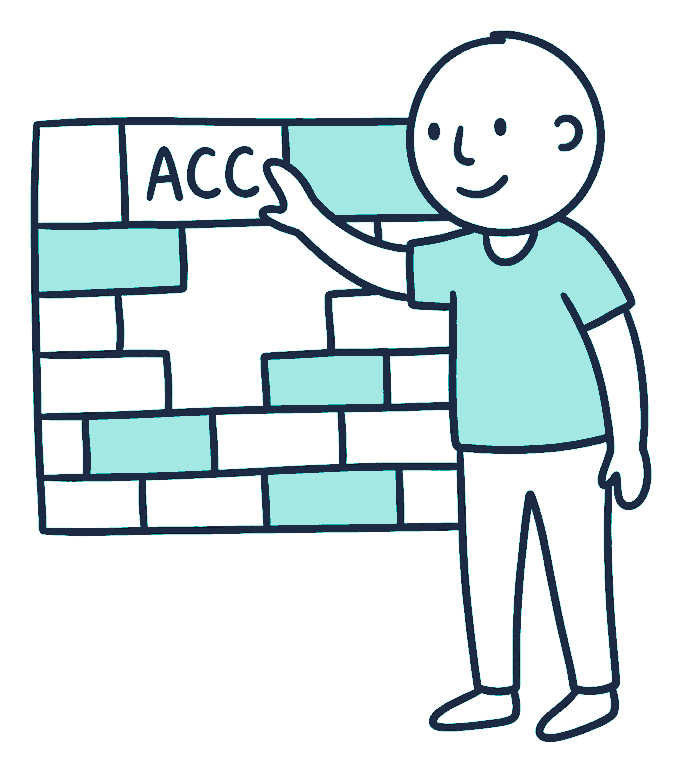
What ACC covers
ACC covers personal injury caused by an accident. It covers every New Zealand resident and every visitor, whatever their job, and nobody has to prove fault or sue anyone.
Covered injury types
- Physical injuries from accidents. Fractures, sprains, dislocations, burns, cuts, concussion and soft-tissue damage from falls, sport, crashes and workplace incidents.
- Work-related gradual process injuries. Conditions built up by work exposure, such as noise-induced hearing loss and occupational overuse syndrome.
- Treatment injuries. Harm caused by treatment from a registered health professional, where the harm was not an ordinary consequence of that treatment.
- Mental injury linked to a covered physical injury. Depression or anxiety that follows an injury ACC already covers.
- Mental injury caused by sexual violence. ACC runs a separate sensitive claims pathway for this.
ACC entitlements for covered injuries
Once a claim is accepted, ACC can pay for treatment, rehabilitation, help at home, childcare and travel to appointments (ACC, What we cover, retrieved 8 September 2026). It can also pay weekly compensation, a lump sum for permanent impairment, and death benefits after a fatal injury.
What ACC does not cover
ACC does not cover illness or disease. It does not cover conditions that come with ageing, standalone mental health conditions, or most gradual conditions that develop away from work (ACC, Injuries we don't cover, retrieved 8 September 2026). Cancer, heart disease, stroke and diabetes attract no income replacement, no treatment funding and no rehabilitation from ACC.
Even on a covered accident, ACC pays up to 80% of what you earned before the injury, before tax and other deductions (ACC, Calculating weekly compensation for employees, retrieved 8 September 2026).
1. Illness and disease

This is the largest gap in the scheme. A cancer diagnosis, a heart attack, a stroke, kidney failure or any other illness draws no weekly compensation, no treatment funding and no rehabilitation from ACC.
That matters because illness, not injury, is what usually keeps people off work for months. ACC covers none of it unless an accident caused it.
2. Degenerative and age-related conditions
Arthritis, disc degeneration and osteoporosis build up over time, so they sit outside the scheme. ACC names "conditions related to ageing, eg arthritis" in its own list of what it does not cover (ACC, retrieved 8 September 2026).
This creates a grey area. If you already have age-related disc degeneration and then slip and herniate a disc, ACC may cover the acute injury and decline the rest once the acute phase has settled. The underlying condition is treated as pre-existing.
3. Mental health conditions, unless injury-linked
Stress, burnout, anxiety and depression are not covered on their own. ACC lists "stress, hurt feelings or other emotional issues" as outside the scheme unless they are connected to a covered injury (ACC, retrieved 8 September 2026). Mental injury caused by sexual violence is the other exception.
So if your mental health stops you working and there is no qualifying physical injury, ACC pays nothing. Mental health is one of the leading causes of long-term income protection claims in New Zealand, which is exactly the risk ACC does not carry.
4. Non-accident gradual conditions
Conditions that build up away from work, such as carpal tunnel from a hobby or chronic pain with no clear traumatic cause, generally fall outside ACC. The gradual process pathway only opens for work exposure.
5. The 20% income gap
Even on a covered accident, ACC replaces up to 80% of your earnings, not all of them. That missing fifth is not a rounding error for a household with a mortgage. Your costs do not fall by 20% because you broke your leg.
ACC weekly compensation: rates, caps and limits
ACC weekly compensation is 80% of your pre-injury gross weekly earnings. It is worked out before tax, then taxed as income. Payment normally starts on day 8, because the first week sits with your employer if the injury happened at work, and it runs until you return to work, reach 65, or ACC decides the entitlement has ended.
The current limits
ACC's published rates carry their own effective dates. Weekly compensation is 80% of pre-injury gross weekly earnings, with a gross maximum of $2,466.20 a week from 1 July 2026 and a full-time minimum of $766.40 a week from 1 April 2026. Maximum liable earnings are $156,641 a year and the earners' levy is $1.75 per $100, both from Inland Revenue.
| Figure | Amount | Effective from |
|---|---|---|
| Compensation rate | 80% of pre-injury gross weekly earnings | Standing rule |
| Maximum weekly compensation, gross | $2,466.20 a week | 1 July 2026 |
| Minimum weekly compensation, full-time earner, gross | $766.40 a week | 1 April 2026 |
| Maximum liable earnings | $156,641 a year | 1 April 2026 |
| Earners' levy | $1.75 per $100 of liable earnings, GST inclusive | 1 April 2026 |
| Stand-down | First week. Your employer pays 80% only if the injury happened at work | Standing rule |
| Tax | Weekly compensation is taxable income | Standing rule |
Sources, in order: the 80% rate from ACC, Calculating weekly compensation for employees (retrieved 8 September 2026); the $2,466.20 gross maximum from ACC, Changes to ACC client payments from 1 July 2026 (published 11 June 2026, retrieved 8 September 2026); the $766.40 full-time minimum, which ACC states is 80% of the adult minimum wage of $958.00 for a 40-hour week, from ACC, Changes to client payments from 1 April 2026 (published 31 March 2026, retrieved 14 August 2026); and the $156,641 cap and $1.75 rate from Inland Revenue, ACC earners' levy rates (retrieved 8 September 2026), which states its amounts include GST. The prior year was $1.67 per $100 on earnings up to $152,790.
What the cap means in practice
The weekly maximum is applied after the 80% calculation. Divide $2,466.20 by 0.8 and you get $3,082.75 a week, or about $160,300 a year. Above that, extra earnings add nothing to an ACC claim. That arithmetic is ours, on ACC's published rate and ceiling.
Annualised, the ceiling is $128,242.40 a year. Note that this sits well below the $156,641 of income you pay levies on.
The three gaps ACC leaves
Put the rules together and the shortfall is not one gap. It is three, and they stack. The 20% gap costs everyone on a covered claim a fifth of gross income. The earnings cap gap opens above about $160,300 a year, the point at which ACC's $2,466.20 weekly maximum stops rising. Illness is the widest of the three, because ACC pays nothing at all when illness rather than injury stops you working.
| Gap | Who it hits | Size |
|---|---|---|
| The 20% gap | Everyone on a covered claim | A fifth of gross income, before tax effects |
| The earnings cap gap | Anyone earning above about $160,300 | Every dollar of earnings above the ceiling |
| The illness gap | Everyone | All of your income, because ACC pays nothing |
Gap 1: the missing fifth
Take someone on $90,000 who cannot work for nine months after a mountain bike crash. ACC pays 80%, so the gross rate is $72,000 a year rather than $90,000. That is $1,500 a month, or $13,500 over nine months. The arithmetic is ours; the 80% rate is ACC's.
There is a tax wrinkle on top. Weekly compensation is taxable and is taxed at source, so the 80% is 80% of gross. In ACC's own worked example, a person on $1,250 a week is paid $1,000 gross, has $300 taken in tax and other deductions, and receives $700 (ACC, Calculating weekly compensation for employees, published November 2025, retrieved 19 August 2026). ACC notes that the $300 bundles PAYE with student loan, KiwiSaver and child support, so yours will differ.
Gap 2: the earnings cap
A self-employed electrician on $180,000 has a different problem. ACC stops at $2,466.20 a week, which annualises to $128,242.40. Over six months off work that is a shortfall of about $25,900 against normal earnings, and the replacement rate is about 71% rather than 80%.
Push the income higher and the gap widens fast. On $250,000 the same fixed ceiling replaces about 51% of earnings. On $300,000 it is about 43%. Those percentages are our arithmetic on ACC's published ceiling of $2,466.20 gross a week from 1 July 2026 (ACC, changes to client payments, read 8 September 2026).
Gap 3: illness
The third gap is the whole income. ACC pays nothing when the cause is illness rather than injury.
Take someone on $100,000 who needs six months off for cancer treatment. Had a crash caused it, ACC would pay 80%. Because an illness caused it, ACC pays zero, and the household is looking at sick leave, savings and whatever private cover it holds. For most people sick leave runs out in weeks, not months.
ACC vs private insurance: a direct comparison
ACC and private cover split sharply by cause, not by how sick or injured you are. A broken leg draws treatment, rehabilitation and weekly compensation at 80% of pre-injury earnings. A cancer diagnosis draws nothing at all from ACC, while income protection pays a monthly benefit for as long as you cannot work and trauma cover pays a lump sum on diagnosis. The five scenarios below show where each one responds.
| Scenario | ACC | Income protection | Health insurance | Trauma cover |
|---|---|---|---|---|
| Broken leg from sport | Treatment, rehab, 80% of income | Also pays, subject to offsets | May fund private treatment | Not triggered |
| Cancer diagnosis | No cover | Pays up to 75% of income | Funds private treatment and specialists | Lump sum on diagnosis |
| Heart attack | No cover | Pays up to 75% of income | Funds private treatment and surgery | Lump sum on diagnosis |
| Workplace back injury | Treatment, rehab, 80% of income | Also pays, subject to offsets | May fund faster private treatment | Not triggered |
| Depression stopping work | No cover unless injury-linked | Pays up to 75% of income | May fund specialist or psychology costs | Usually not triggered |
| Degenerative disc disease | No cover | Pays if you cannot work | Funds private surgery | Not triggered |
| Stroke | No cover | Pays up to 75% of income | Funds private rehabilitation | Lump sum on diagnosis |
The pattern is the point. ACC is strong on accidents. Most of what stops New Zealanders working is not an accident.
What happens when ACC runs out or declines your claim
Weekly compensation is not open-ended. ACC can stop it when it decides your injury has stabilised, when it assesses you as able to do some work, or when it decides your symptoms no longer relate to the original injury. Payments also stop at 65, when New Zealand Superannuation starts. We set out the full list in our guide to when ACC payments stop.
Claim declines
ACC can decline a claim outright where it decides an accident did not cause the condition. This happens most often in mixed cases, such as back pain that is part degenerative and part traumatic. The line between injury and illness is not always clean, and borderline claims get declined.
What you are left with
If ACC declines the claim or ends the entitlement, the options without private cover are thin.
- Sick leave. Eligible employees get a minimum of 10 days a year (Employment New Zealand, Sick leave, retrieved 8 September 2026). That does not carry a serious condition.
- Jobseeker Support. The rate for a single person aged 25 or over is $372.55 a week after tax at the M code, from 1 April 2026 (Work and Income, Benefit rates, retrieved 8 September 2026). It is income tested.
- Savings. Whatever you have, spent in the order you did not plan.
- Family. Real, but not a plan.
How private insurance fills ACC's gaps

Three products cover what the levies do not. Income protection replaces a share of income for illness as well as injury. Health insurance funds private treatment. Trauma cover pays a lump sum on diagnosis.
Income protection insurance
Income protection pays a monthly benefit, commonly up to 75% of gross income, when a medical condition stops you working. It responds to illness as well as accident, which is the whole reason it exists alongside ACC.
On an accident claim it usually behaves differently, because most policies offset your ACC entitlement. If ACC is already paying 80% of the same earnings, a policy written at 75% may pay little on that claim. Where the premium earns its keep is illness, earnings above ACC's ceiling, and claims where ACC reassesses you off compensation.
Four things decide what a policy actually does:
- Benefit period. To age 65 is the widest. Two-year and five-year terms cost less.
- Wait period. Four, eight or thirteen weeks are common. Nothing is paid during it, so your savings have to cover it.
- Agreed value or indemnity. Agreed value fixes the benefit up front. Indemnity works off your earnings at claim time.
- Definition of disability. Own occupation covers you for your own job. Any occupation is a harder test.
Health insurance
Private health cover pays for treatment rather than income. It buys speed and choice of provider.
That matters because the public queue is long. In the December 2025 quarter, 64.5% of people received elective treatment within four months, against a target of 95% (DPMC Government Targets factsheet, Target 2, published 18 June 2026, retrieved 18 August 2026).
Trauma (critical illness) insurance
Trauma cover pays a tax-free lump sum on diagnosis of a listed condition, such as cancer, heart attack or stroke. It does not test whether you can work. You choose what the money is for.

The real cost of being uninsured
Put one household through it. Sarah is 38, earns $95,000, and is diagnosed with breast cancer. She needs six months off.
With ACC only:
- ACC pays $0, because cancer is an illness.
- Sick leave covers 10 days, then stops.
- Jobseeker Support, if she qualifies, pays $372.55 a week after tax (Work and Income, retrieved 8 September 2026), against gross earnings of about $1,827 a week.
- The mortgage does not pause.
With income protection at 75% of income, the monthly benefit would be about $5,940 after the wait period, and the household has something to plan around. Those are our figures from her stated income, not a quote.
The difference between the two columns is the difference between a hard year and a forced sale.
Five steps to closing your ACC gaps
- Check what ACC would actually pay you. If you are self-employed, check that your levies and your declared income match what you earn now. ACC works off your last filed return.
- Work out your runway. Count how many weeks your household could run with no income. Most people find the number is low.
- Start with income protection. It is the only one of the three that replaces income for illness as well as injury.
- Then consider health insurance. It addresses the treatment side, and the waiting list.
- Get advice. A licensed financial adviser can size the cover against your own numbers and compare the insurers on our panel. Our ACC gap calculator is a fast first pass.
Frequently Asked Questions
Does ACC cover me if I get cancer?
No. ACC covers personal injury caused by an accident, and cancer is an illness. There is no weekly compensation, no treatment funding and no rehabilitation from ACC. Income protection replaces income and health insurance funds private treatment.
How much does ACC pay per week?
Up to 80% of your pre-injury gross weekly earnings. From 1 July 2026 the gross maximum is $2,466.20 a week and the full-time minimum is $766.40 a week (ACC, retrieved 8 September 2026). The payment is taxed, so what lands is less than the gross figure.
What happens if I earn more than the ACC cap?
The 80% is applied and then capped at $2,466.20 a week. That is $128,242.40 a year. Earnings above about $160,300 a year add nothing to the claim, so the higher your income the lower your real replacement rate.
Can I have both ACC and income protection?
Yes, and it is normal. ACC covers accident. Income protection covers accident and illness. On an accident claim most policies offset the ACC entitlement, so read the offset wording. On an illness claim the policy pays in full, because ACC pays nothing.
What happens if ACC declines my claim?
You can apply for a review of the decision, and you can appeal a review outcome to the District Court. You are not paid weekly compensation while that runs. If you hold income protection, your insurer assesses your claim against its own policy definition, not against ACC's decision.
Does ACC cover mental health conditions?
Only in two situations: mental injury that follows a covered physical injury, and mental injury caused by sexual violence. Standalone depression, anxiety, burnout or PTSD without a qualifying injury are not covered.
Is ACC enough if I am self-employed?
Often not. On standard CoverPlus, weekly compensation is based on your most recently completed financial year, so a business that has grown since the last return is covered on the old figure. ACC also does not fund business overheads while you are off. Our guide to ACC for contractors and the CoverPlus and CoverPlus Extra comparison go through the options.
Sources
Every figure above is reproduced from ACC, Inland Revenue, Work and Income, Employment New Zealand or DPMC, with the date the page was read.
- ACC, Injuries we don't cover (retrieved 8 September 2026): illness, ageing-related conditions and emotional issues sit outside the scheme.
- ACC, What we cover (retrieved 8 September 2026): the entitlements a covered claim opens.
- ACC, Calculating weekly compensation for employees (retrieved 8 September 2026): ACC usually pays up to 80% of pre-injury income, before tax and deductions.
- ACC, Calculating weekly compensation for employees, guide PDF (published November 2025, retrieved 19 August 2026): the $5,000, $1,250, $1,000, $300, $700 worked example.
- ACC, Changes to ACC client payments from 1 July 2026 (published 11 June 2026, retrieved 8 September 2026): gross maximum weekly compensation of $2,466.20.
- ACC, Changes to client payments from 1 April 2026 (published 31 March 2026, retrieved 14 August 2026): gross minimum of $766.40 for a full-time earner.
- ACC Annual Report 2025 (published 9 October 2025, retrieved 18 August 2026): claims accepted and claims paid for the year to 30 June 2025.
- Inland Revenue, ACC earners' levy rates (retrieved 8 September 2026): $1.75 per $100 GST inclusive and maximum earnings of $156,641 for 1 April 2026 to 31 March 2027.
- Work and Income, Benefit rates from 1 April 2026 (retrieved 8 September 2026): Jobseeker Support of $372.55 a week after tax at M for a single person aged 25 or over.
- Employment New Zealand, Sick leave (retrieved 8 September 2026): the 10-day minimum entitlement.
- DPMC, Government Targets factsheet, Target 2 (published 18 June 2026, retrieved 18 August 2026): 64.5% treated within four months in the December 2025 quarter.
This article is general information only and is not personalised financial advice. ACC entitlement figures are stated with their effective dates. The weekly maximum is reviewed on 1 July and the levy year figures on 1 April, so check acc.co.nz before relying on them. Where a number is described as our arithmetic, it is our working on ACC's published rates and not an ACC figure. Financial advice is provided by Craig Smith Business Services Limited, trading as Smiths Insurance & KiwiSaver, a licensed Financial Advice Provider (FSP712931). QuoteHub is a trading name. Henry Smith is a Financial Adviser (FSP1010699).
Read the full insurance guides
Compare your cover with a licensed NZ adviser · free, no obligation.
Explore related pages: Life Insurance, Income Protection, Health Insurance, Trauma Insurance, Compare Insurance NZ.