Health Insurance Excess NZ: How It Works and How to Choose
QuoteHub treats the health insurance excess as one of the most important decisions you will make when setting up a policy. It directly determines how much you pay out of pocket each time you claim, and it has a significant impact on your monthly premiums. Choosing the wrong level can either leave you paying more than necessary in premiums or leave you with an uncomfortable bill when you actually need treatment.
Yet many New Zealanders select their excess almost as an afterthought, or simply accept whatever the insurer defaults to. This guide explains exactly how health insurance excess works in New Zealand, walks through the common excess levels, shows how each level affects your premiums, and provides a clear framework for choosing the right amount for your situation.
What is a health insurance excess?
A health insurance excess, sometimes called a deductible, is the amount you agree to pay towards a claim before your insurer covers the rest. With a $500 excess and a $12,000 knee arthroscopy, you pay the first $500 and the insurer pays the remaining $11,500. Almost every health insurance policy in New Zealand carries one.
For example, if you have a $500 excess and you need a $12,000 knee arthroscopy, you pay the first $500 and your insurer pays the remaining $11,500.
The excess is a core feature of virtually every health insurance policy in New Zealand. It exists because it serves both parties: it reduces your premiums (since the insurer is not covering every dollar from the first cent), and it discourages very small or unnecessary claims, which helps keep premiums lower across the board.
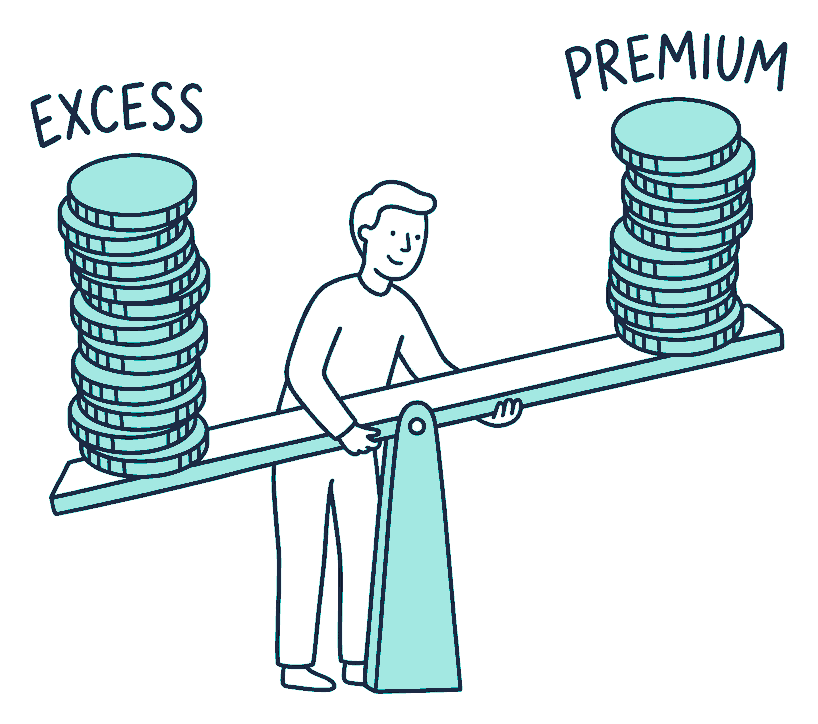
The key trade-off is straightforward. A higher excess means lower monthly premiums but more out-of-pocket cost when you claim. A lower excess means higher monthly premiums but less financial impact when treatment is needed.
How excess works in practice
Claiming on a New Zealand health insurance policy follows five steps: you receive treatment, submit the claim with invoices, the insurer assesses it against your policy terms, the insurer pays the approved amount minus your excess, and you pay the excess either directly to the provider or as the unpaid portion of the claim. The excess applies only to eligible claims.
- You receive treatment (for example, a specialist consultation or surgical procedure).
- You submit your claim to your insurer with the relevant invoices.
- The insurer assesses the claim against your policy terms.
- If approved, the insurer pays the total approved amount minus your excess.
- You pay the excess amount, either directly to the provider or as the unpaid portion of your claim.
The excess applies to eligible claims only. If your policy does not cover a particular treatment, the excess is irrelevant because the entire cost sits with you regardless.
Per-claim excess vs annual excess
This is an important distinction that many policyholders overlook, and it can significantly affect your total out-of-pocket costs.
Per-claim excess (also called per-event excess)
With a per-claim excess, you pay the excess amount every time you make a separate claim. If you have a $500 per-claim excess and you make three claims in one year, you pay $500 three times, totalling $1,500 in excess payments.
Most New Zealand health insurers use a per-claim or per-event structure for their surgical and major medical benefits. This is the most common arrangement.
Annual excess (also called aggregate excess)
With an annual excess, you pay the excess amount once per policy year, regardless of how many claims you make. Using the same example, if you have a $500 annual excess and make three claims, you pay $500 for the first claim and then nothing further for the remaining two claims that year.
Annual excess options are less common but are offered by some insurers. They tend to be more expensive in terms of premiums because they limit your total out-of-pocket exposure in any given year.
Which type your policy uses matters. If you are someone who expects to make multiple claims in a year (for example, ongoing treatment for a chronic condition, or a family with young children needing frequent specialist visits), an annual excess structure could save you a considerable amount compared to paying per claim.
Common excess levels in New Zealand
New Zealand health insurers typically offer excess levels of $0, $250, $500, $1,000 and $2,000, with $500 the most popular choice because it balances premium savings against manageable out-of-pocket costs. Some providers also offer $100, $750 or even $5,000 options depending on the plan type, though those sit outside the standard mainstream range.
| Excess level | Description |
|---|---|
| $0 (nil excess) | You pay nothing out of pocket when you claim. Premiums are at their highest. |
| $250 | A small contribution per claim. Modest premium reduction. |
| $500 | The most popular choice. Balances premium savings with manageable out-of-pocket costs. |
| $1,000 | A meaningful premium discount. Requires comfortable savings for unexpected claims. |
| $2,000 | Maximum premium savings. Best suited to those with strong financial reserves. |
Some insurers offer levels outside this range. You may see $100, $750, or even $5,000 excess options depending on the provider and plan type. However, the levels above represent the standard choices available across most mainstream health insurance products in New Zealand.
How excess affects your premiums
Choosing a higher excess lowers your health insurance premium, but the saving is not linear. Moving from a nil excess to $500 delivers the biggest proportional reduction for a comprehensive hospital and specialists plan, while stepping from $1,000 to $2,000 adds a smaller incremental benefit. Actual savings vary by insurer, age, region and plan type in New Zealand.
How each excess level moves the premium
| Excess level | Relative premium level | Saving vs $0 excess |
|---|---|---|
| $0 | Highest | Baseline: no saving |
| $250 | High | Modest |
| $500 | Moderate | The largest single step down from the baseline |
| $1,000 | Low | Meaningful, but a smaller additional step than the one before it |
| $2,000 | Lowest | The smallest incremental gain for the largest out-of-pocket exposure |
The pattern above holds for a comprehensive hospital and specialists plan. Where your own premium lands depends on your insurer, region, age and plan type, so treat this as the shape of the trade-off rather than a quote.
Several things stand out from this comparison:
- Moving from a nil excess to $500 produces a worthwhile annual premium saving. If you make fewer than one claim per year on average, you come out ahead with the $500 excess.
- Moving to a $2,000 excess saves more again, but you need to be confident you can cover a $2,000 bill at short notice if you need treatment.
- The savings are not linear. The jump from $0 to $500 provides the biggest proportional saving. Going from $1,000 to $2,000 delivers a smaller incremental benefit.
Running the maths: when does a higher excess pay off?
A higher excess pays off for New Zealand policyholders only when claims are rare, because the right comparison is total annual cost, meaning premiums plus any excess payments. On a per-claim structure, one claim a year makes a $250 or $500 excess roughly break even, two claims a year make a nil excess the better value, and claim-free years favour a $2,000 excess.
Example 1: One claim per year
Suppose you make one claim per year (a common scenario for someone who might need one specialist consultation, procedure, or diagnostic investigation annually).
| Excess level | Relative annual premium | Excess paid (1 claim) | Relative total annual cost |
|---|---|---|---|
| $0 | Highest | $0 | Slightly above the best option |
| $250 | High | $250 | Lowest total cost in this scenario |
| $500 | Moderate | $500 | Almost identical to the $250 option |
| $1,000 | Low | $1,000 | Higher: the excess starts to outweigh the premium saving |
| $2,000 | Lowest | $2,000 | Highest: one claim erases the premium saving |
With one claim per year, the $250 excess is the sweet spot in this example. The $500 excess is almost identical. At $1,000 and above, the excess payment starts to outweigh the premium savings.
Example 2: No claims in a year
If you do not claim at all in a given year (which is common for younger, healthier policyholders), your total cost is simply your premiums. In that scenario the ranking inverts completely: the $2,000 excess is the cheapest outcome and the nil excess the most expensive, and the gap compounds with every claim-free year you string together.
Example 3: Two claims per year (per-claim excess)
| Excess level | Relative annual premium | Excess paid (2 claims) | Relative total annual cost |
|---|---|---|---|
| $0 | Highest | $0 | Lowest total cost in this scenario |
| $250 | High | $500 | Higher than nil excess |
| $500 | Moderate | $1,000 | Higher again |
| $1,000 | Low | $2,000 | Materially higher |
| $2,000 | Lowest | $4,000 | Highest by a wide margin |
With two claims per year on a per-claim excess, the nil excess is clearly the best value. Every excess level above $0 costs you more in total. This is why understanding how frequently you are likely to claim is so important.
When to choose a high excess
A high excess of $1,000 or $2,000 suits younger New Zealanders in good health, people with a savings buffer who could cover that amount at short notice, and those who treat health insurance as catastrophic cover for major events such as surgery or cancer treatment. If a $2,000 bill would cause financial stress, the level is too high.
- Are younger and in good health. If you are in your 20s or 30s with no ongoing health conditions, your likelihood of claiming in any given year is lower. A higher excess lets you bank the premium savings during the years you do not claim.
- Have a savings buffer. You need to be able to comfortably cover the excess amount at short notice. If a $2,000 unexpected expense would cause financial stress, a $2,000 excess is the wrong choice regardless of the premium savings.
- View insurance as catastrophic cover. Some people prefer to self-insure for smaller medical costs and use their health insurance only for major, high-cost events like surgery or cancer treatment. A high excess aligns with this approach.
- Want to keep premiums as low as possible. If premium affordability is the primary concern and you are comfortable accepting higher out-of-pocket costs when claiming, a higher excess makes the policy more sustainable long-term.
When to choose a low excess
A low excess of $0 or $250 suits New Zealanders who expect to claim frequently, families with children who may need grommets, tonsillectomies or dental work under general anaesthetic, and anyone whose savings would not stretch to $1,000 or $2,000 at short notice. A policy you cannot afford to claim on is not real protection.
- Expect to claim frequently. If you have a known health condition requiring ongoing specialist treatment, or a family history that makes claims more likely, a lower excess reduces your total cost across multiple claims.
- Have a family with children. Families tend to make more claims than individuals, particularly for children who may need grommets, tonsillectomies, dental work under general anaesthetic, or specialist paediatric consultations. A per-claim excess of $500 or more adds up quickly with two or three claims per year.
- Have limited savings. If finding $1,000 or $2,000 at short notice would be difficult, a lower excess ensures you can actually afford to use your insurance when you need it. An insurance policy you cannot afford to claim on is not providing real protection.
- Want predictability. Some people simply prefer knowing their out-of-pocket cost will be minimal when they claim. The peace of mind of a low or nil excess is worth the higher premiums for many policyholders.
How New Zealand insurers structure excess options
New Zealand insurers apply excess on a per-claim basis as the standard for hospital and surgical cover, with levels typically ranging from $0 to $2,000 and $250, $500 and $1,000 the most common. GP and day-to-day claims often carry separate smaller co-payments, some plans waive the excess for cancer claims, and some insurers treat related treatment as one claim event.
| Feature | Common approach |
|---|---|
| Excess structure | Per-claim is the standard for hospital and surgical cover |
| Excess levels offered | Typically $0 to $2,000, with $250, $500, and $1,000 being the most common |
| GP and day-to-day claims | Often have separate, smaller excess or co-payment structures |
| Specialists and diagnostics | Usually subject to the main policy excess |
| Surgical and hospital claims | Always subject to the main policy excess |
| Excess waiver for cancer | Some plans waive the excess for cancer-related claims |
| Combined excess for related treatment | Some insurers treat related treatment as one claim event |
It is worth noting that some insurers allow you to set different excess levels for different benefit categories. For example, you might choose a $1,000 excess for surgical claims (which are infrequent but high-cost) and a lower excess for specialist consultations (which are more frequent but lower-cost). This can be a smart way to optimise your premium spend without creating uncomfortable out-of-pocket exposure.
When comparing policies, always confirm whether the excess is per claim, per condition, or per policy year. This single detail can change your total annual cost by hundreds or even thousands of dollars.

Tips for choosing the right excess
Choosing the right excess in New Zealand starts with estimating how often you have needed specialist treatment, imaging or surgery in recent years, then confirming whether your excess is charged per claim or per policy year. Match the level to what you could pay from your emergency fund tomorrow, and review it at each annual renewal, which most insurers allow without new medical underwriting.
Estimate your likely claims frequency. Think about the past few years. How often have you or your family members needed specialist treatment, diagnostic imaging, or surgery? Use this as a baseline for your excess decision.
Check whether your excess is per claim or annual. As outlined above, this makes a significant difference to your total out-of-pocket cost if you claim more than once per year.
Match your excess to your savings. Your excess should be an amount you could comfortably pay tomorrow without financial stress. If you could not cover it from your emergency fund, it is too high.
Consider your life stage. A single 28-year-old and a family with three children under 10 have very different expected claims profiles. Your excess should reflect your current reality, not just your desire for lower premiums.
Review your excess annually. Your circumstances change over time. An excess level that made sense five years ago may no longer be the best fit. Most insurers allow you to adjust your excess at renewal without medical underwriting.
Do not fixate on excess alone. The excess is just one part of your total cost of cover. A policy with a low excess but poor benefit limits, restrictive sub-limits, or extensive exclusions may end up costing you more overall than a well-structured policy with a moderate excess.
If you are unsure which excess level is right for you, talking to an adviser can help you work through the numbers based on your specific situation and budget.
Frequently Asked Questions
What is a typical health insurance excess in New Zealand?
The most common excess level chosen by New Zealand policyholders is $500. This provides a meaningful premium reduction while keeping out-of-pocket costs manageable for most people. However, the "right" excess depends on your individual circumstances, claims history, and financial position.
Can I change my excess after taking out a policy?
Yes. Most New Zealand health insurers allow you to change your excess level at your annual renewal date. Increasing your excess (which lowers premiums) is generally straightforward. Decreasing your excess (which raises premiums) may sometimes require a review, but it typically does not require new medical underwriting.
Does the excess apply to every type of claim?
This depends on your policy. Most policies apply the main excess to surgical, hospital, and specialist claims. Some policies have separate co-payment structures for GP visits, prescriptions, or day-to-day benefits. Check your policy wording or ask your insurer to confirm exactly which benefits are subject to the excess.
Is excess the same as a co-payment?

Not exactly. An excess is a fixed dollar amount you pay before the insurer covers the rest. A co-payment (or co-pay) is typically a percentage of the claim that you pay, with the insurer covering the remaining percentage. Some policies use both mechanisms. For example, you might have a $500 excess plus a 20% co-payment on the remaining balance. Always check whether your policy includes co-payments in addition to the excess.
Should I choose the highest excess to get the cheapest premiums?
Not necessarily. The cheapest premiums do not always represent the best value. If you end up making a claim and cannot comfortably afford the excess, the premium savings are meaningless. The right excess is one that balances affordable premiums with an out-of-pocket amount you can genuinely pay when needed. Compare your options to see how different excess levels affect your specific premiums.
Does ACC affect my health insurance excess?
ACC covers treatment costs for injuries caused by accidents, so your health insurance excess typically only applies to non-accident medical conditions. If your treatment is covered by ACC, your health insurance excess is not relevant for that claim. However, if ACC declines a claim or if the condition is illness-related rather than injury-related, your health insurance (and its excess) would apply. You can read more about what ACC does and does not cover.
The bottom line
Your health insurance excess is not a set-and-forget decision. It is a lever you can adjust to balance your premiums against your willingness and ability to pay out of pocket when you claim.
For most New Zealanders, a $500 excess hits the right balance. It provides meaningful premium savings without creating a financial barrier to claiming. But your ideal level depends on your health, your family situation, your savings, and how you prefer to manage risk.
The key is to make a deliberate choice rather than defaulting to whatever the insurer suggests. Run the numbers, consider how often you are likely to claim, and make sure you could comfortably cover the excess amount if you needed treatment tomorrow.
If you would like help working out the right excess for your situation, get in touch with our adviser team. We can walk you through the options across multiple insurers and help you find the right balance of cover and cost.
Financial advice is provided by Craig Smith Business Services Limited, trading as Smiths Insurance & KiwiSaver, a licensed Financial Advice Provider (FSP712931). QuoteHub is a trading name. Henry Smith is a Financial Adviser (FSP1010699). The information in this article is general in nature and does not constitute personalised financial advice. We recommend speaking with a licensed financial adviser before making insurance decisions. QuoteHub advisers can help you compare policies and find the right fit for your situation.
References
- Financial Markets Authority (FMA), Insurance guidance
- ACC New Zealand
- Sorted.org.nz, Insurance guides
- Insurance & Financial Services Ombudsman (IFSO)
- MoneyHub NZ, Insurance resources
- Cancer Society of New Zealand
- ACC New Zealand, What we cover
- NZ Dental Association
Read the full insurance guides
Compare your cover with a licensed NZ adviser · free, no obligation.
Explore related pages: Life Insurance, Income Protection, Health Insurance, Trauma Insurance, Compare Insurance NZ.