Agreed Value vs Indemnity Insurance NZ: Which Protects You Better?
Income protection insurance is the cover QuoteHub sees households regret not holding more than any other. It replaces a portion of your income if you cannot work due to illness or injury, keeping your household afloat when your earning ability is compromised.
But not all income protection policies work the same way. In New Zealand, there are two fundamentally different structures for calculating your benefit: agreed value and indemnity. The one you choose can mean the difference between a smooth claims experience and a stressful, uncertain process at the very time you can least afford complications.
This guide explains exactly how each structure works, runs through real claim scenarios, compares costs and tax treatment, and provides a clear decision framework to help you choose.
The Core Difference
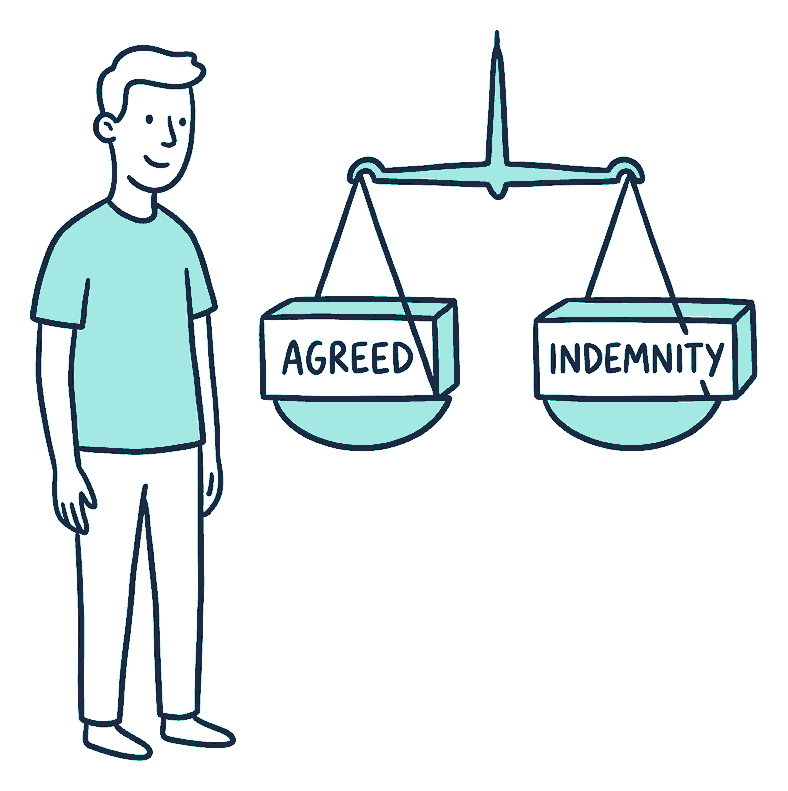
In New Zealand, agreed value and indemnity income protection differ over when your benefit amount is determined. Agreed value locks the monthly benefit in at application, typically up to 62.5% of gross pre-tax income, and pays that amount regardless of your earnings at claim time. Indemnity calculates the benefit at claim, at up to 75% of proven pre-disability income.
Agreed value: Your benefit is locked in at the time you apply for the policy. You prove your income upfront, and the insurer agrees to pay a set monthly amount if you claim. That amount does not change, regardless of what your income looks like at claim time.
Indemnity: Your benefit is calculated at the time you make a claim. The insurer assesses your income at that point (typically looking at the previous 12 to 24 months of financial records) and pays a percentage of that proven income.
This seemingly simple timing difference has significant practical consequences.
How Each Structure Calculates Your Benefit
Agreed value and indemnity income protection in New Zealand calculate your benefit at different points in time. Agreed value sets a monthly amount at application from tax returns, financial statements or payslips, typically up to 62.5% of gross pre-tax income. Indemnity assesses income at claim time using the 12 to 24 months before the claim, paying up to 75% minus offsets.
Agreed value: locked in at application
When you apply for agreed value income protection, you provide evidence of your current income. This might include:
- Recent tax returns (typically the last two to three years)
- Financial statements for self-employed individuals
- Employment contracts and payslips for employees
- Accountant's confirmation of income
Based on this evidence, the insurer agrees to a monthly benefit amount, typically up to 62.5% of your gross pre-tax income. This figure is written into your policy. If your claim is accepted and you have served the waiting period (usually 4 to 13 weeks), you receive this amount each month for the duration of your benefit period, regardless of what your income was doing immediately before you became unable to work.
Indemnity: assessed at claim time
With indemnity cover, you do not need to provide detailed income evidence when you apply (though some basic verification may be required). The real assessment happens when you claim.
At that point, the insurer asks you to prove your pre-disability income, typically using financial records from the 12 to 24 months before your claim. Your monthly benefit is then calculated as up to 75% of that proven pre-disability income, minus any offsets (ACC payments, sick leave, other income sources).
The higher percentage (75% vs 62.5%) might look attractive on paper, but it comes with a critical caveat: the amount you actually receive depends entirely on what you can prove at the time you need to claim.
Side-by-Side Comparison
Agreed value and indemnity income protection in New Zealand differ across benefit timing, cost and tax. Agreed value sets the benefit at application at up to 62.5% of income, generally pays non-taxable benefits and costs more in premiums. Indemnity sets the benefit at claim at up to 75% of pre-disability income, is taxable as income, and carries higher claim dispute risk.
| Feature | Agreed Value | Indemnity |
|---|---|---|
| When benefit is set | At application | At claim time |
| Maximum benefit percentage | Up to 62.5% of income | Up to 75% of pre-disability income |
| Income proof required | At application (tax returns, accounts) | At claim time (recent financial records) |
| Claim process complexity | Simpler. Benefit is predetermined. | More complex. Must prove income loss. |
| Tax treatment of benefits | Generally non-taxable | Taxable as income |
| Premium cost | Higher (due to payout certainty) | Lower (payout is variable) |
| Protection if income drops | Full benefit still applies | Benefit reduces proportionally |
| Protection if income rises | May become underinsured | Benefit may increase (if proven) |
| Best suited for | Self-employed, variable income, commission earners | Stable salaried employees with consistent income |
| Claim dispute risk | Lower | Higher |
Real Claim Scenarios
Real claim scenarios show how far apart agreed value and indemnity payouts can fall. A self-employed New Zealand builder who insured $120,000 of income and later dropped to $70,000 receives a monthly benefit of $6,250 non-taxable under agreed value, but roughly $3,700 after tax under indemnity, a gap of nearly $2,550 each month.
Scenario 1: The self-employed tradie whose income dropped
Background: Sam is a self-employed builder earning $120,000 per year. He takes out income protection at age 35. Three years later, a downturn in the construction industry reduces his income to $70,000. Shortly after, he suffers a serious back injury and cannot work.
Under agreed value: Sam's benefit was set at 62.5% of $120,000 = $75,000 per year ($6,250 per month). Despite his income having dropped to $70,000, he receives $6,250 per month (non-taxable). This actually exceeds his recent take-home pay, providing a comfortable financial buffer during recovery.
Under indemnity: The insurer looks at Sam's income over the prior 12 to 24 months, which averaged approximately $70,000. His benefit is 75% of $70,000 = $52,500 per year ($4,375 per month), and this amount is taxable. After tax, Sam receives roughly $3,500 to $3,700 per month. A significant reduction from what he would have received under agreed value.
Difference: Agreed value pays approximately $6,250/month (non-taxable). Indemnity pays approximately $3,700/month (after tax). That is nearly $2,550 per month less under indemnity.
Scenario 2: The employee with a stable salary
Background: Emma is a marketing manager earning a consistent $95,000 salary. She has been in the same role for four years with predictable annual pay increases.
Under agreed value: Benefit set at 62.5% of $95,000 = $59,375 per year ($4,948 per month), non-taxable.
Under indemnity: Benefit calculated at 75% of $95,000 = $71,250 per year ($5,937 per month), but taxable. After tax (at roughly 30% marginal rate on this amount), Emma receives approximately $4,156 per month.
Difference: Agreed value pays approximately $4,948/month (non-taxable). Indemnity pays approximately $4,156/month (after tax). Even for a stable employee, agreed value delivers a better after-tax outcome in this example due to the non-taxable treatment.
Scenario 3: The career changer
Background: James is a software developer earning $140,000. He takes out indemnity income protection. Two years later, he decides to retrain as a teacher, earning $55,000. He is then diagnosed with a chronic illness that prevents him from working.
Under agreed value (if he had chosen it): Benefit locked at 62.5% of $140,000 = $87,500 per year ($7,292 per month), non-taxable. His career change would have had no impact on his benefit.
Under indemnity: Benefit based on his recent teacher's salary: 75% of $55,000 = $41,250 per year ($3,437 per month), taxable. After tax, approximately $2,750 to $2,900 per month.
Difference: This scenario illustrates the most dramatic gap. Agreed value would have paid $7,292/month. Indemnity pays under $3,000/month after tax. The career change, which seemed like a positive life decision, dramatically reduced his financial safety net.
Scenario 4: The new parent taking time off
Background: Sarah is a consultant earning $110,000. She takes out income protection, then goes on parental leave for 12 months, during which her income is minimal. Shortly after returning to part-time work (earning $40,000), she develops a serious illness.
Under agreed value: Benefit remains at 62.5% of $110,000 = $68,750 per year ($5,729 per month), non-taxable. Her parental leave and reduced hours do not affect the payout.
Under indemnity: The insurer examines her income over the prior 12 to 24 months, which includes the parental leave period. Her average provable income might be assessed at $40,000 or less. Benefit: 75% of $40,000 = $30,000 per year ($2,500 per month), taxable.
Difference: Agreed value pays $5,729/month. Indemnity pays approximately $2,000/month after tax. This is one of the most common scenarios where indemnity cover fails to deliver adequate protection.
Tax Treatment: A Significant Factor
Tax treatment separates agreed value and indemnity income protection more than the headline benefit percentages suggest. Agreed value benefits are generally non-taxable in New Zealand while the premiums are not deductible. Indemnity benefits are taxable as income while the premiums are tax-deductible, so a 75% indemnity benefit can deliver less in hand than a 62.5% agreed value benefit.
| Aspect | Agreed Value | Indemnity |
|---|---|---|
| Tax on benefit payments | Non-taxable | Taxable as income |
| Tax on premiums | Not deductible | Premiums are tax-deductible |
| Net effect | Higher after-tax benefit, but premiums come from after-tax income | Lower after-tax benefit, but premiums reduce taxable income |
For many people, the non-taxable benefit of agreed value outweighs the premium deductibility of indemnity. However, the right answer depends on your marginal tax rate, income level, and how long you expect to claim. A licensed financial adviser can model both scenarios for your specific situation.
Cost Difference: What You Pay in Premiums
Agreed value income protection costs more than indemnity. This is because the insurer takes on more risk. They are guaranteeing a fixed payout regardless of your circumstances at claim time, so they price accordingly.
The premium difference varies by insurer, age, occupation, waiting period, and benefit period, but the direction of the effect is consistent:
| Policy Structure | Relative premium level | Why it prices that way |
|---|---|---|
| Agreed value (4-week wait, to age 65) | Higher | The insurer guarantees a fixed monthly benefit regardless of your income at claim time, so it carries the full risk of your income falling |
| Indemnity (4-week wait, to age 65) | Lower | The benefit is recalculated from proven income at claim, so the insurer's exposure moves with your circumstances |
The gap between the two is the price of certainty, not a difference in the quality of the cover. Your own premium varies significantly based on:
- Age: Older applicants pay more.
- Occupation: Higher-risk occupations (tradies, manual workers) cost more than office-based roles.
- Waiting period: Shorter waiting periods (2 weeks) increase premiums. Longer waiting periods (13 weeks, 26 weeks) reduce them.
- Benefit period: Cover to age 65 or 70 costs more than a 2-year or 5-year benefit period.
- Stepped vs level premiums: Stepped premiums start lower but increase annually with age. Level premiums start higher but remain stable.
- Bundling: Combining income protection with life, trauma, or TPD cover may attract multi-policy discounts.
The higher cost of agreed value is, in essence, the price of certainty. You are paying more now to remove uncertainty at claim time.
Who Each Structure Suits
Agreed value suits people whose provable income can fall, and indemnity suits people whose income is stable and documented. Self-employed New Zealanders, contractors, commission earners, career changers and new parents benefit most from a locked-in agreed value benefit. Salaried employees with predictable payslips, and those in the first two to three years of self-employment, are usually offered indemnity.
Agreed value is generally better for:
- Self-employed individuals and contractors. Income fluctuates with business conditions, and proving consistent income at claim time can be difficult. Agreed value eliminates this risk entirely.
- Commission-based earners. Sales professionals, real estate agents, and others whose income varies month to month benefit from having a locked-in amount.
- People who may change careers. If you anticipate a career shift to a lower-paying role (teaching, non-profit work, starting a business), agreed value preserves the protection based on your higher income.
- New parents or those planning to reduce hours. Parental leave or part-time work reduces your provable income under indemnity, but has no effect on agreed value benefits.
- Anyone who values certainty. If the idea of having to prove your income loss while dealing with a serious illness or injury concerns you, agreed value removes that burden.
Indemnity may suit:
- Employees with stable, well-documented salaries. If your income is predictable, provable via payslips, and unlikely to decrease, the claim process under indemnity is manageable.
- People in the early years of self-employment. Insurers typically require two to three years of financial accounts to offer agreed value. New business owners may only qualify for indemnity initially.
- Budget-conscious buyers. If the premium difference is the deciding factor and your income is stable, indemnity provides meaningful cover at a lower cost.
- Those with growing incomes. Under indemnity, if your income has increased substantially since you took out the policy, your benefit at claim time may be higher than the amount that would have been locked in under agreed value. (However, you can update your agreed value periodically to account for income growth.)

Proving Income Under Indemnity: The Practical Reality
Proving income under an indemnity claim in New Zealand means supplying tax returns for the past two to three years, financial statements, bank statements, payslips and details of other income including ACC payments. The insurer then applies offsets and calculates your pre-disability income, a process that can take weeks and delay payments beyond the waiting period.
Under indemnity, you will typically need to provide:
- Tax returns for the past two to three years
- Financial statements (profit and loss, balance sheet) for self-employed claimants
- Bank statements showing income deposits
- Employment confirmation and payslips for employees
- Details of any other income sources (rental income, investments, ACC payments)
The insurer will then calculate your pre-disability income, apply offsets for other income you are receiving during disability, and determine your monthly benefit. This process can take weeks, delaying the start of payments beyond the waiting period.
For self-employed individuals with complex income structures (trusts, companies, variable drawings), the process can be particularly challenging. Disputes over what constitutes "income" are more common with indemnity claims.
Risks and Limitations of Each
Agreed value and indemnity income protection each carry distinct risks in New Zealand. Agreed value can leave you underinsured if your income grows after the benefit is locked in, and it costs more in premiums over a 30-year policy life. Indemnity reduces your payout whenever income falls before a claim, taxes the benefit, and deducts offsets such as ACC payments and employer sick pay.
Agreed value risks
- Underinsurance over time. If your income grows significantly after you set your agreed value, you may be underinsured. Review your cover annually and apply for increases.
- Higher premiums. The cost difference is real and ongoing. Over a 30-year policy life, the cumulative premium difference is substantial.
- Income proof at application. You must be able to demonstrate your income when you apply. If your recent income has been unusually low, the agreed value will be set at that lower level.
Indemnity risks
- Reduced benefit if income drops. Any reduction in income before a claim directly reduces your payout. This includes voluntary changes (career shifts, parental leave) and involuntary ones (redundancy, business downturn).
- Claim complexity. The requirement to prove income at claim time adds administrative burden and potential for disputes.
- Tax on benefits. Taxable benefits mean your after-tax payment is materially lower than the headline percentage suggests.
- Offsets. ACC payments, employer sick pay, and other income sources are typically deducted from your indemnity benefit, further reducing the amount you receive.
Provider Availability
All major New Zealand income protection insurers offer both agreed value and indemnity options, including AIA, Partners Life, Fidelity Life, Asteron Life, nib and Accuro, though Accuro's agreed value availability is limited. Which insurer suits you best depends on your occupation, age, health and the specific policy features you need, so comparing across providers matters.
| Provider | Agreed Value | Indemnity | Notable Features |
|---|---|---|---|
| AIA | Yes | Yes | Strong product range, widely used |
| Partners Life | Yes | Yes | Flexible policy structures |
| Fidelity Life | Yes | Yes | 2025 pricing updates for both structures |
| Asteron Life (Acenda Group) | Yes | Yes | Established provider |
| nib | Yes | Yes | Competitive pricing |
| Accuro | Limited | Yes | Primarily health-focused |
Most advisers will recommend discussing both options and running premium comparisons across multiple providers. The "best" insurer depends on your occupation, age, health, and the specific features you need.
Transitioning from Indemnity to Agreed Value
Transitioning from indemnity to agreed value is a common path for self-employed New Zealanders who cannot prove enough income history at the outset. Insurers typically require two to three years of financial accounts, after which most allow conversion without new medical underwriting, adjusting the policy structure once you supply the evidence and accepting the higher agreed value pricing.
Here is how this typically works:
Years 1 to 2 of self-employment: You have limited financial history. Insurers offer indemnity cover based on your projected income or early accounts.
Year 3 onwards: Once you have two to three years of financial accounts showing a stable income level, you can apply to convert to agreed value.
Conversion process: Many insurers allow this conversion without requiring new medical underwriting. You simply provide the financial evidence, and the insurer adjusts your policy structure. The premium will increase to reflect the agreed value pricing.
Hybrid option: Some people hold both an agreed value and an indemnity policy simultaneously to maximise total cover. The agreed value portion pays its locked-in benefit, while the indemnity portion tops up based on proven income at claim time. This requires careful structuring to avoid over-insurance, so work with a licensed adviser.
Decision Framework
Choosing between agreed value and indemnity income protection in New Zealand comes down to how stable and provable your income is. Agreed value fits if your income varies by more than 15 to 20% year on year, if you are self-employed, a contractor or commission-based, or if you plan a career change, business start or parental leave in the next 5 to 10 years.
Choose agreed value if:
- Your income varies by more than 15 to 20% year on year
- You are self-employed, a contractor, or commission-based
- You plan to change careers, start a business, or take parental leave in the next 5 to 10 years
- You want the simplest possible claims process
- You can comfortably afford the higher premium
Choose indemnity if:
- Your salary is stable and well-documented
- You are in the early years of self-employment and cannot yet qualify for agreed value
- The premium difference is a genuine barrier to getting any cover at all
- Your income is trending upward and you want your benefit to reflect that at claim time
Important: Having indemnity income protection is far better than having no income protection at all. If the cost of agreed value is preventing you from getting cover, indemnity is a sound alternative. The worst outcome is being uninsured entirely.
Frequently Asked Questions
Can I switch from indemnity to agreed value later?
Yes. Most NZ insurers allow you to convert from indemnity to agreed value once you can provide two to three years of financial evidence. The conversion typically does not require new medical underwriting, though it will require income verification. Your premium will increase to reflect the agreed value structure.
Is agreed value always better than indemnity?
Not always. For employees with a stable, well-documented salary, the claim process under indemnity is straightforward, and the higher cover percentage (75% vs 62.5%) can sometimes result in a comparable after-tax benefit. However, for most people, particularly those with variable income, agreed value provides superior certainty.
How does ACC affect my income protection benefit?

Most income protection policies in NZ include an ACC offset. If you are receiving ACC payments for an accident-related disability, your income protection benefit is reduced by the ACC amount. This applies to both agreed value and indemnity structures. The offset prevents you from receiving more than your pre-disability income from combined sources.
Can I hold both agreed value and indemnity policies at the same time?
Yes. Some people hold a base level of agreed value cover for certainty, topped up with an indemnity policy to capture higher income. The total insured amount across both policies must not exceed your actual income, and the indemnity claim will still require income proof. This strategy requires careful advice to structure correctly.
What happens if my income increases after I take out agreed value?
Your locked-in benefit stays at the original level until you actively apply for an increase. Most insurers allow you to increase your agreed value (subject to income proof and sometimes further medical underwriting). It is good practice to review your cover annually and apply for increases when your income grows significantly.
How long does an indemnity claim take to process?
Indemnity claims typically take longer than agreed value claims because of the income verification process. Expect 4 to 8 weeks from submitting your claim to receiving the first payment, depending on how quickly you can provide the required financial documentation and how complex your income structure is. Agreed value claims are generally faster since the benefit amount is already determined.
Are agreed value premiums tax-deductible?
No. Agreed value premiums are paid from after-tax income. The trade-off is that the benefits you receive are non-taxable. Indemnity premiums, by contrast, are tax-deductible, but the benefits are taxable as income. The net effect depends on your specific tax situation.
References
- Financial Markets Authority (FMA), Insurance guidance
- ACC New Zealand
- Sorted.org.nz, Insurance guides
- Insurance & Financial Services Ombudsman (IFSO)
- Consumer Protection NZ
- ACC New Zealand, What we cover
- IRD, Income tax rates
- Business.govt.nz, Running a business
- Financial Markets Authority (FMA), "Income Protection Insurance Guidance," fma.govt.nz, accessed March 2026.
- Fidelity Life, "Income Protection Product Disclosure Statement," fidelitylife.co.nz, accessed March 2026.
- Partners Life, "Income Protection: Agreed Value vs Indemnity," partnerslife.co.nz, accessed March 2026.
- AIA New Zealand, "Income Protection Insurance," aia.co.nz, accessed March 2026.
- Sorted, "Income Protection Insurance," sorted.org.nz, accessed March 2026.
- IRD New Zealand, "Tax Treatment of Insurance Payments," ird.govt.nz, accessed March 2026.
- Asteron Life, "Income Protection Plans," asteronlife.co.nz, accessed March 2026.
- Fidelity Life, "2025 Pricing and Product Updates," fidelitylife.co.nz, accessed March 2026.
Disclaimer: This article is for informational purposes only and does not constitute financial or insurance advice. Financial advice is provided by Craig Smith Business Services Limited, trading as Smiths Insurance & KiwiSaver, a licensed Financial Advice Provider (FSP712931). QuoteHub is a trading name. Income protection insurance products, pricing, and policy terms vary between providers and change over time. Always read the full policy wording and consider seeking advice from a licensed financial adviser before making insurance decisions. Information is current as at March 2026.
Read the full insurance guides
Compare your cover with a licensed NZ adviser · free, no obligation.
Explore related pages: Life Insurance, Income Protection, Health Insurance, Trauma Insurance, How It Works.