Income Protection Waiting Period NZ: What a Longer Wait Actually Saves
Cross-reading two published New Zealand quote grids for the same five insurers, the same age and the same sex, a four-week waiting period on cover to age 65 was priced 51% to 113% above a 13-week wait. The saving is real. So is the cost of taking it: on a $6,000 monthly benefit, the 13-week option asks you to fund $18,000 of living costs yourself instead of $5,538.
That trade is the whole decision, and it is almost always presented as a one-sided choice. Policywise's own waiting period guide describes the trade-off accurately in words, "shorter periods mean higher premiums; longer ones lower costs but require savings", and publishes no prices against it (retrieved 19 August 2026). This page puts numbers on both sides.
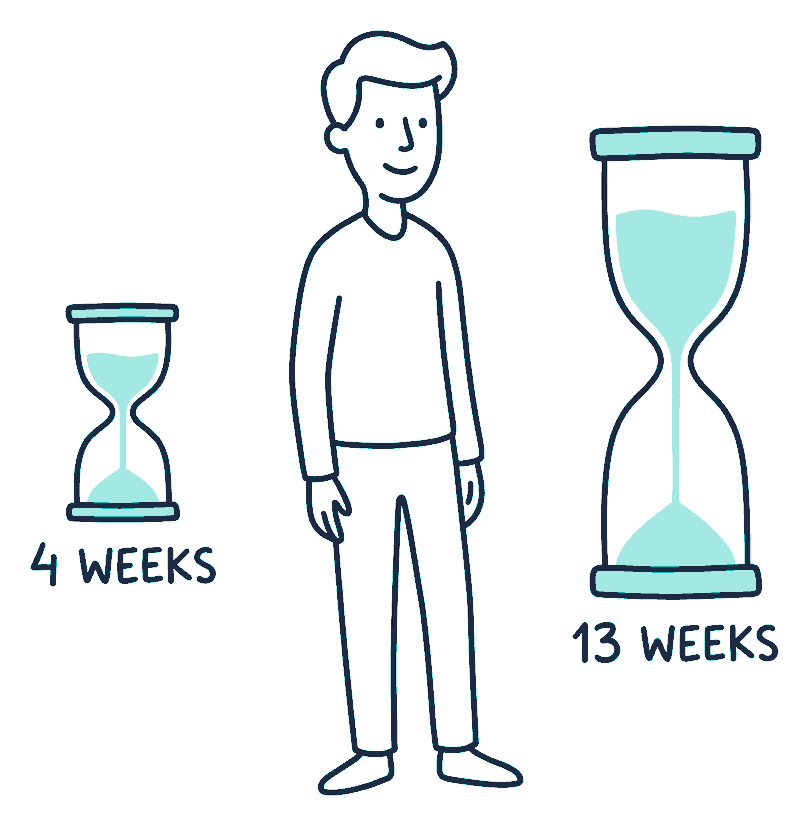
What does a longer waiting period actually save?
The cleanest published answer comes from a single rate card, so nothing else varies. SuperLife publishes its disability income rate schedules by waiting period: one month, three months and six months, priced per $1,000 of annual cover, by age and job category. The tables are dated 2 November 2009 and are workplace-scheme rates, so read them for the shape of the relationship rather than the level.
Cost index for a category A job with cover to age 65, with the one-month wait set to 100 at each age, from SuperLife's published male rate schedules for a one-month, three-month and six-month waiting period, all dated 2 November 2009 (retrieved 19 August 2026). The index is our arithmetic on the publisher's rates.
| Age | One-month wait | Three-month wait | Six-month wait |
|---|---|---|---|
| 25 | 100 | 49 | 41 |
| 30 | 100 | 40 | 34 |
| 35 | 100 | 41 | 36 |
| 40 | 100 | 46 | 42 |
| 45 | 100 | 54 | 49 |
| 50 | 100 | 63 | 57 |
| 55 | 100 | 69 | 63 |
Two findings sit in that grid, and neither is in general circulation.
The saving is almost entirely bought in the first three months. At 35, moving from a one-month to a three-month wait takes the rate down by 59%, from $7.03 to $2.87 per $1,000 of annual cover. Moving on from three months to six months takes it to $2.50, another 13% off what you were still paying (SuperLife rate schedules, dated 2 November 2009, retrieved 19 August 2026). You have already banked most of the discount by the time you reach a three-month stand-down, and everything after that is a large increase in the risk you carry for a small reduction in price.
The discount shrinks as you age. At 30 a three-month wait costs 40% of the one-month price. At 55 the same choice costs 69%. The longer wait is a young person's discount, because a longer stand-down mostly screens out short claims, and short claims are a bigger share of a young person's risk. If you are over 50 and stretching the waiting period to make the price work, you are getting less than half the discount a 30-year-old gets for the same increase in exposure.
What the current market charges: four weeks against 13 weeks
Nobody in New Zealand publishes one insurer's price at several waiting periods. What we can do is read two grids that overlap on everything except the wait. MoneyHub publishes annual premiums for a 35-year-old non-smoking male office worker with a $6,250 monthly benefit and a four-week wait (updated 11 June 2026). Policywise publishes fortnightly figures for a 35-year-old non-smoking employed male with a $6,000 monthly benefit and a 13-week wait (retrieved 19 August 2026). Five insurers appear on both.
Below, the MoneyHub figures are scaled to a $6,000 benefit by multiplying by 6.0 and dividing by 6.25, and the Policywise figures are annualised by multiplying by 26. Both are published illustrations only, not quotes, and the comparison crosses two publishers, so treat it as an order of magnitude rather than a measurement.
| Insurer | Four-week wait, annual | 13-week wait, annual | Four weeks costs more by |
|---|---|---|---|
| Fidelity Life | $1,292.75 | $853.32 | 51.5% |
| AIA | $1,469.95 | $862.16 | 70.5% |
| Asteron Life | $1,630.44 | $952.64 | 71.2% |
| Chubb | $1,449.92 | $760.50 | 90.7% |
| Partners Life | $1,454.95 | $683.28 | 112.9% |
Source figures: MoneyHub NZ (updated 11 June 2026, retrieved 19 August 2026) and Policywise (retrieved 19 August 2026). Scaling and the final column are our arithmetic.
The spread in that last column matters more than its average. Partners Life charges more than twice as much for the short wait; Fidelity Life charges half as much again. Choosing a four-week wait is a cheap decision at one insurer and an expensive one at another, and no comparison page will tell you which, because each publishes only one waiting period.
What you must hold to bridge the gap
Here is the side of the trade that never gets charted. A waiting period is not a discount. It is a decision to self-fund your own living costs for that period, and the amount is knowable to the dollar.
Cash required to bridge each waiting period on a $6,000 monthly benefit, being the weekly equivalent of that benefit multiplied by the number of weeks. QuoteHub arithmetic. Waiting period options as published by Chubb Life (retrieved 19 August 2026).
| Waiting period | Cash you must hold | Equivalent in months of the benefit |
|---|---|---|
| 4 weeks | $5,538 | 0.9 |
| 8 weeks | $11,077 | 1.8 |
| 13 weeks | $18,000 | 3.0 |
| 26 weeks | $36,000 | 6.0 |
| 52 weeks | $72,000 | 12.0 |
| 104 weeks | $144,000 | 24.0 |
A $6,000 monthly benefit corresponds to roughly a $96,000 salary at the standard 75% replacement level, so those figures are the household's own outgoings, not a theoretical number. If you cannot see $18,000 sitting somewhere you can reach in a fortnight, a 13-week waiting period is not a cheaper policy. It is a policy with a hole in the front of it.
The payback test nobody runs
Put the two sides together and the choice resolves itself. Take the premium you save by lengthening the wait, and ask how long it would take that saving to accumulate the extra cash the longer wait requires.
On the five insurers above, moving from a four-week to a 13-week wait increases the cash you must hold by $12,462 and saves between $439 and $772 a year. The payback runs from 16 to 28 years.
| Insurer | Annual saving, four weeks to 13 weeks | Years for that saving to fund the extra $12,462 |
|---|---|---|
| Partners Life | $771.67 | 16.1 |
| Chubb | $689.42 | 18.1 |
| Asteron Life | $677.80 | 18.4 |
| AIA | $607.79 | 20.5 |
| Fidelity Life | $439.43 | 28.4 |
Figures derived from MoneyHub NZ (updated 11 June 2026) and Policywise (retrieved 19 August 2026) as set out above.
Run the same test further along the curve using the one publisher who prices both ends, and it stops being a close call. On SuperLife's schedule, a 35-year-old in category A with cover to 65 pays $506.16 a year at a one-month wait, $206.64 at three months and $180.00 at six months, for $72,000 of annual cover (rates dated 2 November 2009, retrieved 19 August 2026, arithmetic ours). Stretching from one month to three months saves $299.52 a year against $12,462 of extra exposure, a 42-year payback. Stretching from three months to six months saves $26.64 a year against $18,000 of extra exposure. That is a payback measured in centuries.
Which is the honest way to state the rule: a longer waiting period is not a way to fund a longer waiting period. It only works if the cash already exists. Choose the wait to match the buffer you actually hold, not the price you want to reach.
What waiting periods are actually offered
Chubb Life publishes waiting periods of 4, 8, 13, 26, 52 or 104 weeks on its Assurance Extra Income Cover (Chubb Life brochure, retrieved 19 August 2026). Across the six insurers on Policywise's feature grid, AIA, Asteron Life and Fidelity Life also offer a two-week option, while Chubb, nib and Partners Life start at four weeks (retrieved 19 August 2026).
The two-week option is worth knowing about and is rarely the right answer. It sits at the steepest part of the price curve, and it duplicates cover that most employees already hold in the form of sick leave.
Sick leave will not bridge it
Eligible employees in New Zealand are entitled to 10 days of paid sick leave a year (Employment New Zealand, retrieved 19 August 2026). Ten days is two working weeks. Even the shortest commonly offered waiting period leaves an employee with a two-week gap, and that assumes a full untouched entitlement, which almost nobody has by the time something serious happens.
Two further points that change the sum:
- Accumulated sick leave changes the answer entirely. Some employers carry entitlements over, and some offer extended sick pay schemes. If you have three months of employer-funded sick pay, a four-week waiting period is buying you cover you already have, and a 13-week wait probably costs you nothing in real exposure. Check the actual entitlement before choosing.
- The self-employed have none of this. There is no sick leave. The waiting period is funded entirely from working capital, and the business usually stops earning at the same moment. That is the group for whom the short wait is most valuable and most expensive.
What happens during the waiting period
Not always nothing. Chubb's Income Cover pays a bed confinement benefit of one thirtieth of the monthly sum insured for each night, if you are hospitalised or confined to bed for more than three nights in a row, running until the end of the waiting period (Chubb Life brochure, retrieved 19 August 2026). The same brochure sets out a recurrent disablement benefit which waives the waiting period if the same illness or injury puts you off work again within 12 months.
If the cause is an accident rather than an illness, ACC weekly compensation may be running through the whole of your waiting period at up to 80% of pre-injury earnings, capped at $2,466.20 gross a week from 1 July 2026 (ACC Newsroom, retrieved 14 August 2026). That is the case for stretching the wait. The case against it is that ACC does not cover illness, sickness or conditions related to ageing (ACC, retrieved 14 August 2026), and illness is the majority of what actually keeps people off work: Partners Life reports that accident and injury caused 42% of its Income Cover claims in the year to 31 March 2025, with cancer at 15%, heart at 11%, mental health disorders at 10% and musculoskeletal at 7% (Partners Life, *This is Partners Life 2025* claims brochure, claims assessed 1 April 2024 to 31 March 2025, retrieved 18 August 2026).
So the ACC bridge covers a minority of the events that trigger a claim. Sizing your waiting period on the assumption that ACC will carry you is sizing it for 42% of the risk.
How to choose, in order
- Add up your genuinely liquid savings, cash you could spend in a fortnight without selling anything or asking anyone.
- Add any employer sick pay you would actually receive, in weeks, not in theory.
- Take the smaller of that total and what you would be willing to spend before insurance takes over. That is your waiting period, converted to weeks.
- Only then look at the price, and check it at your two nearest options rather than the one the illustration happens to use.
The order matters. Choosing the wait from the price is how people end up with a policy they cannot reach.
Honest limits
- The waiting-period relationship above comes from a rate schedule dated 2 November 2009. It is used for shape, presented as an index, and should not be read as current retail pricing.
- The four-week against 13-week comparison crosses two publishers, two benefit amounts and possibly two occupation definitions. It is directionally sound and it is not a like-for-like measurement.
- No New Zealand publisher prices the 8, 52 or 104-week options at all, on any profile we could find. Those three points on the chart above have a cash cost and no published price. Only an adviser running the quote software can fill them in.
- The bridge figures assume your outgoings equal the benefit you insured. If you insured less than you spend, the real gap is larger.
Getting the number for your own buffer
Sizing a waiting period is arithmetic on your own bank balance plus a quote at two or three different waits. QuoteHub is operated by Craig Smith Business Services Limited, trading as Smiths Insurance and KiwiSaver, a licensed Financial Advice Provider (FSP712931), and can price the same cover at several waiting periods so you can see the trade rather than assume it. The insurers we work with are listed on our disclosure page, and we are paid commission by the insurer if you take out cover.
The full price picture by age, occupation and insurer sits alongside this, and the waiting and benefit period mechanics are covered separately.
References
- SuperLife, Disability income insurance rate schedules, male, one-month wait, three-month wait and six-month wait (all dated 2 November 2009, retrieved 19 August 2026), rate per $1,000 of annual cover by age and job category
- MoneyHub NZ, Compare Income Protection Insurance (updated 11 June 2026, retrieved 19 August 2026), five insurers, four-week wait
- Policywise, Best income protection insurance and comparison quotes (retrieved 19 August 2026), six insurers, 13-week wait, and the published waiting period options per insurer
- Policywise, Income protection waiting period guide (retrieved 19 August 2026)
- Chubb Life, Assurance Extra Income Cover brochure (retrieved 19 August 2026), waiting period options, bed confinement and recurrent disablement benefits
- Employment New Zealand, sick leave (retrieved 19 August 2026)
- ACC Newsroom, changes to client payments from 1 July 2026 (retrieved 14 August 2026)
- ACC, injuries we do not cover (retrieved 14 August 2026)
- Partners Life, This is Partners Life 2025 claims brochure (claims assessed 1 April 2024 to 31 March 2025, retrieved 18 August 2026)
Disclaimer: This article is general information only and does not constitute personalised financial advice. Every price on this page is reproduced from the named third-party publication beside it, or derived from those figures with the arithmetic shown, and is not a quote from QuoteHub or from any insurer. Insurance is subject to underwriting, and terms, conditions, exclusions and stand-down periods apply. QuoteHub is operated by Craig Smith Business Services Limited, trading as Smiths Insurance and KiwiSaver, a licensed Financial Advice Provider (FSP712931), Christchurch.
Read the full insurance guides
Compare your cover with a licensed NZ adviser · free, no obligation.
Explore related pages: Life Insurance, Income Protection, Health Insurance, Trauma Insurance, Referral.